
Hire AI developers who've already shipped one to production.
We're an AI development company that builds AI agents, voice interfaces, and the operational software behind them, then runs one ourselves. Most agencies pitching AI can show you a proposal. We can show you a live system taking real calls.
What we've shipped
We built a live AI product, and we still operate it.
ARA AI is a multi-tenant SaaS AI phone receptionist we built end to end in-house: voice agents, telephony, the booking engine, the multi-tenant dashboard, billing, and the marketing site. It's live and taking calls right now across Saudi Arabia, the UAE, Kuwait, Qatar, Bahrain, and Oman, with signup-to-live onboarding in 48 hours. That is the proof we lead with as an AI agent development company: a system you can check, rather than a claim you take on trust.
One agent, many businesses
One voice agent per business doesn't scale: every onboarding needs provisioning, and every prompt update becomes a migration. Instead, many business phone numbers route to one shared agent. On an inbound call, the system identifies the tenant from the number dialed and loads that tenant's config: business name, locations, services, booking rules, hours, language, and vertical behaviour. Onboarding a new business is a config change, not a deployment.
The backend decides, not the model
The agent can explain options conversationally, but it can't invent availability or bypass a rule. The API evaluates tenant rules in real time when a slot is checked, then validates again before writing, because availability can change mid-call. It handles double-booking prevention, buffer times, per-type durations, and cancellation policy, with clinic and restaurant modes that each enforce their own rules.
What makes voice AI viable, not a demo
Three things make voice AI viable instead of a demo: latency low enough that a caller feels heard while the agent checks availability, interruption handling for callers who talk over the agent or change their mind mid-sentence, and a confirmation read-back before anything is written or changed. That last one is a safety step, not decoration. Honest AI disclosure is built into the conversation design too: Hala, the voice agent, doesn't pretend to be human.
Built for regulated, multilingual markets
Tenant separation is enforced by Postgres Row Level Security at the database layer, not just in application code, so it holds even if an API path gets refactored later (not a compliance badge by itself, healthcare deployments still need their own jurisdiction-specific review). The dashboard ships in Arabic and English with full RTL support built in from the start: form layouts, navigation, date formatting, and local currency, not bolted on afterward. The voice agent answers in English today, with Arabic planned for a later release.
War story
A telephony migration in one week, zero downtime
We started on Telnyx, and it proved unreliable for GCC numbers, which is existential for a product whose entire value is answering the phone. We migrated the whole telephony layer to DIDlogic in one week with zero downtime for existing customers. The tradeoff: DIDlogic needed manual provisioning that Telnyx had automated, so we built internal tooling to absorb that work ourselves rather than pass it to customers or slip the 48-hour signup-to-live promise. The best vendor on paper isn't always the best vendor in your target market.
War story
The third agent whose only job is to hang up
Retell's native call-drop wasn't reliable enough, and a bad ending is noticeable in a receptionist product. We built a dedicated third agent whose only job is to gracefully end out-of-scope calls. It has no booking tools and no business tools, which also makes it a security barrier: a caller attempting prompt injection has nowhere to steer it, because those tools simply aren't in its context. Don't rely on one general agent to do everything safely. Split responsibilities when the failure modes differ.
Voice: Retell AI. Dashboard: React + TanStack. Database and auth: Supabase (PostgreSQL, Row Level Security). API: Hono. Billing: Stripe. Telephony: DIDlogic. For the full breakdown, read the engineering case study.
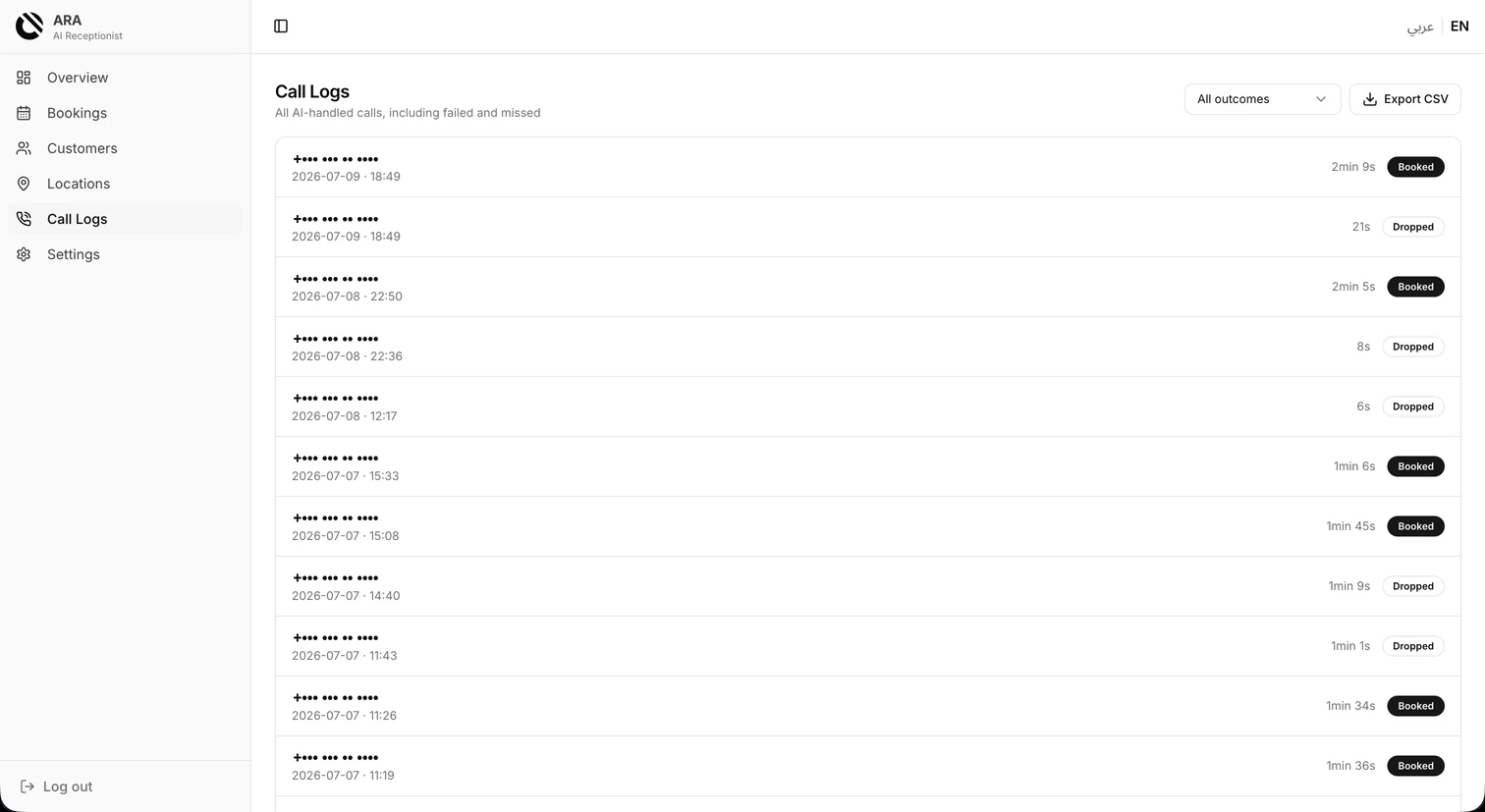
Want the team behind ARA AI building yours?
Book a discovery callWhat we build
AI agents, voice interfaces, and the software that has to sit behind them.
Custom AI development services should cover more than a chatbot bolted onto a homepage: the agent, the backend rules it defers to, and the admin tools someone has to use to run it after launch.
Voice & conversational agents
Natural phone and chat agents with tool calling, built on providers like Retell AI, tuned for latency, interruption handling, and honest AI disclosure.
LLM integrations & agent tooling
Agents that gather intent and call real APIs, while your backend keeps authority over what actually gets written or changed.
Operational software
The multi-tenant dashboard, billing and metered usage, admin and provisioning tools: the parts that turn an agent into something you can run and support.
Data & backend architecture
Tenant isolation, database-level security policies, and rules engines that validate against real state instead of trusting a model's output.
How we work
What hiring us actually looks like.
We've delivered 23+ projects end to end. The shape of an engagement stays the same whether it's an AI agent or a platform: talk first, start fast, ship every week.
Step 1
Book a discovery call, or start with a Roadmap Sprint
If the use case still needs validating, the Roadmap Sprint is a $2,500, two-week audit: opportunity mapping, feasibility, and a prioritized plan. If you go ahead, the full cost is credited toward the build.
Step 2
Start within 48 hours
Most engagements begin within 48 hours of the discovery call, with a scope and a sprint plan, not a month of estimates.
Step 3
See a working build in one to two weeks
Weekly delivery from there. You talk to the people building it, not an account manager relaying updates.
That's the whole process. No proposal deck, no procurement runaround.
Start a projectWhy not a marketplace
We're not the only option. Here's how to think about the others.
Search for an AI developer for hire and most results are marketplaces or staff-aug shops. Both can work. Here's the honest tradeoff, not a pitch against them. Whether you want a full build or need to hire an AI engineer for something narrower, the real question is the same: who owns this once it's live?
You're vetting a profile and a rate, often across a call or two, with no shared context on what you're actually trying to ship. Fine for a narrow, well-specified task. Harder for a product that needs judgment calls as it goes.
More process, more account management, more layers between you and whoever is actually writing the code. Useful for scale you don't have yet. Slower for a first working build.
The person specifying your project has already shipped this exact class of system to production and still operates it. You're not hiring someone to learn AI agents on your budget.
Before you hire
What to look for when you hire an AI developer.
This checklist is genuinely useful even if you don't hire us: it's what we'd ask, if we were on the other side of the table.
Start with the operational rules, not the voice model
Ask what the agent is allowed to do, what it must never do, and what needs confirmation before anything is written. A candidate who jumps straight to "which LLM" hasn't thought about the failure modes yet.
Conversation and authority should be separate
The AI should gather intent and explain options. Your backend should decide availability, enforce policy, and create records. If a demo lets the model write directly with no check, ask what happens when it's wrong.
If you'll serve many customers, ask about config vs. custom builds
A single-tenant custom build per customer doesn't scale past a handful of clients. Dynamic config on a shared agent is the difference between a product you can operate and a pile of one-off deployments.
Ask about the boring parts, not the demo
The question isn't whether someone can connect an LLM to a phone call. It's whether they can ship provisioning, billing, tenant isolation, admin tools, failure handling, and support workflows. That's most of the actual work.
FAQ
Questions worth asking before you hire an AI developer.
Do you only build the AI agent, or the software around it too?
Both. An agent that can talk is not a product. It needs a backend that enforces your rules, a dashboard someone can actually use, billing, and a way to onboard the next customer without an engineer touching code. We build all of it, because we run one ourselves.
How is this different from hiring an AI developer on Upwork or Toptal?
On a marketplace you're reading a profile and a rate. With us, the person scoping your project designed and operates a production AI system, so the conversation starts from what actually breaks in the field, not from a portfolio deck.
Can you build a multi-tenant AI product, not just a single custom agent?
Yes. That's the harder problem, and it's the one we've already solved: many customers routed to one shared agent, with each tenant's rules, language, and business logic loaded from config instead of a separate deployment.
What if I'm not sure AI is the right fit for what I'm building?
Start with the Roadmap Sprint: a $2,500, two-week audit that maps your use case, checks feasibility honestly, and gives you a prioritized plan. If you move forward, the full cost is credited toward the build.
How fast can you start, and how fast will I see something working?
Most engagements start within 48 hours of the discovery call, and you'll see a working first build within one to two weeks.
Do you handle regulated or sensitive data?
We design tenant isolation at the database layer with Postgres Row Level Security, not just application checks, so it holds up even if the API code changes later. That said, it's not a compliance badge by itself: regulated deployments like healthcare still need their own jurisdiction-specific review, and we scope that with you upfront.
Ready to hire an AI developer who's already shipped one to production?