Healthcare IT Consulting: Strategy, Services, and What to Expect
 Hamza Imran··22 min read
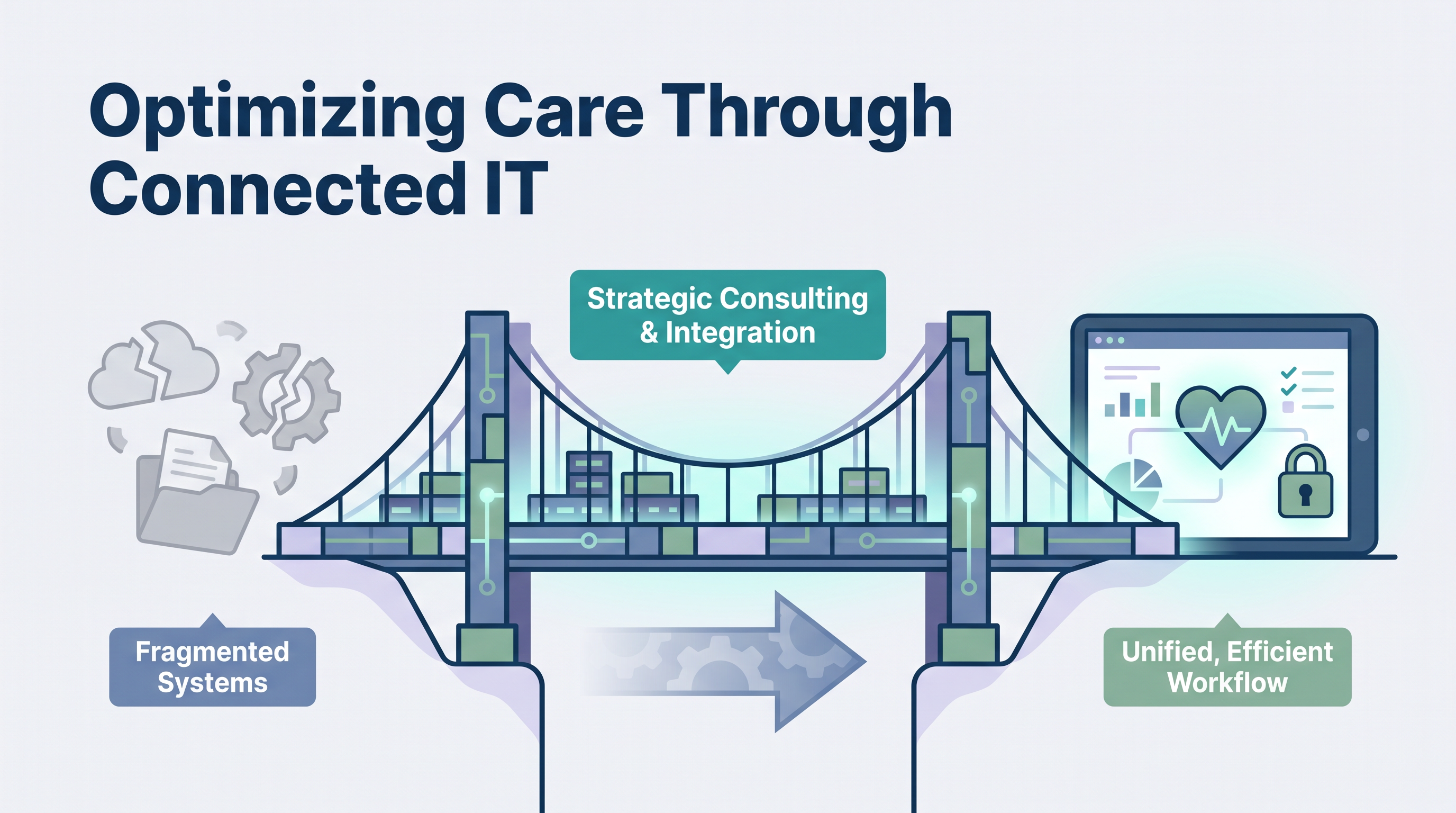
Your scheduling team wants to replace phone calls and spreadsheets. Clinicians want fewer logins. Leadership wants better reporting. Meanwhile, security and compliance teams need evidence that any new platform will protect patient data, support appropriate access controls, and fit the organization’s regulatory obligations.
These demands often get compressed into a single request: “We need new software.” But software selection or development is only one part of the decision. Before committing budget, you need to understand which workflows should change, which systems must exchange data, what should be purchased versus built, and how implementation will affect staff and patients.
Healthcare IT consulting provides that decision-making structure. A focused engagement can turn a collection of technical complaints and feature requests into a practical architecture, sourcing strategy, implementation plan, and set of measurable outcomes.
What Is Healthcare IT Consulting?
Healthcare IT consulting helps healthcare providers, digital health companies, payers, laboratories, and related organizations make technology decisions in environments where privacy, clinical risk, interoperability, and operational continuity matter. The work can cover enterprise IT strategy, custom software planning, EHR integration, infrastructure, cybersecurity, analytics, AI implementation, and workflow modernization.
A consultant should not begin by assuming that every problem requires a new application. A referral backlog, for example, might result from missing system integration, inconsistent data entry, limited scheduling capacity, or an approval process built around email. Building another dashboard would expose the backlog without necessarily removing its cause.
The value of consulting is therefore not just technical knowledge. It is the ability to connect technology decisions to clinical, operational, financial, security, and product considerations. The outcome should be a decision that your organization can implement, not a collection of high-level observations.
How healthcare IT consulting differs from general healthcare consulting
General healthcare consulting frequently concentrates on business strategy, operating models, reimbursement, organizational design, service-line performance, or clinical transformation. Those engagements may discuss technology, but technology is not always the central unit of analysis.
Healthcare IT consulting goes deeper into how systems should be selected, designed, connected, secured, and operated. A consultant may analyze whether an EHR can support a proposed workflow, determine how patient identity will be reconciled across systems, or define the API and data architecture for a digital health product. The work can include detailed questions such as whether to use HL7 v2 messages or FHIR APIs, where protected health information will be stored, how audit logs will be retained, and what happens when an external service becomes unavailable.
The distinction matters when you evaluate potential partners. A strategy firm may be able to recommend consolidating fragmented patient access processes, but a technology-focused team should also explain how scheduling, identity, messaging, consent, and EHR integration would work. It should identify dependencies, estimate implementation complexity, and clarify which components can be configured versus custom-built.
Some projects require both capabilities. An enterprise EHR replacement, for example, affects governance, staffing, clinical workflows, reporting, infrastructure, and vendor management. In that case, you may need healthcare operations expertise combined with architecture, security, data migration, and implementation specialists.
When an organization may need IT strategy support
A visible technology failure is not required before consulting becomes useful. Organizations often seek support when they have several reasonable technology requests but no agreed method for prioritizing them. Department leaders might simultaneously request patient self-scheduling, AI-assisted document review, a new CRM, revenue-cycle automation, and a data warehouse.
Strategy support is especially valuable before a large software purchase or custom build. Once a vendor contract is signed or development has started, changing the core architecture becomes more expensive. A short assessment before procurement can reveal that a proposed platform lacks a required integration method, stores data in an unsuitable region, or cannot support the organization’s role-based access requirements.
You may also need healthcare IT consulting when:
- Staff re-enter the same information into multiple systems.
- Reports require manual spreadsheet reconciliation.
- A patient-facing product must support HIPAA or GDPR obligations.
- An acquired clinic uses different EHR, identity, or billing systems.
- A digital health startup is moving from prototype to production.
- An existing product needs AI features without exposing sensitive data.
- Leadership cannot determine whether to buy, configure, integrate, or build.
- An aging custom system depends on undocumented code or a single employee.
- Operational growth is causing scheduling, dispatch, intake, or case-management bottlenecks.
Regulatory expansion is another common trigger. A product entering both US and European markets cannot treat HIPAA and GDPR as interchangeable checklists. They differ in scope, legal roles, individual rights, processing requirements, and enforcement. Teams planning for both markets can use this comparison of HIPAA and GDPR requirements for health software to frame early architecture and governance decisions.
Healthcare IT Consulting Services
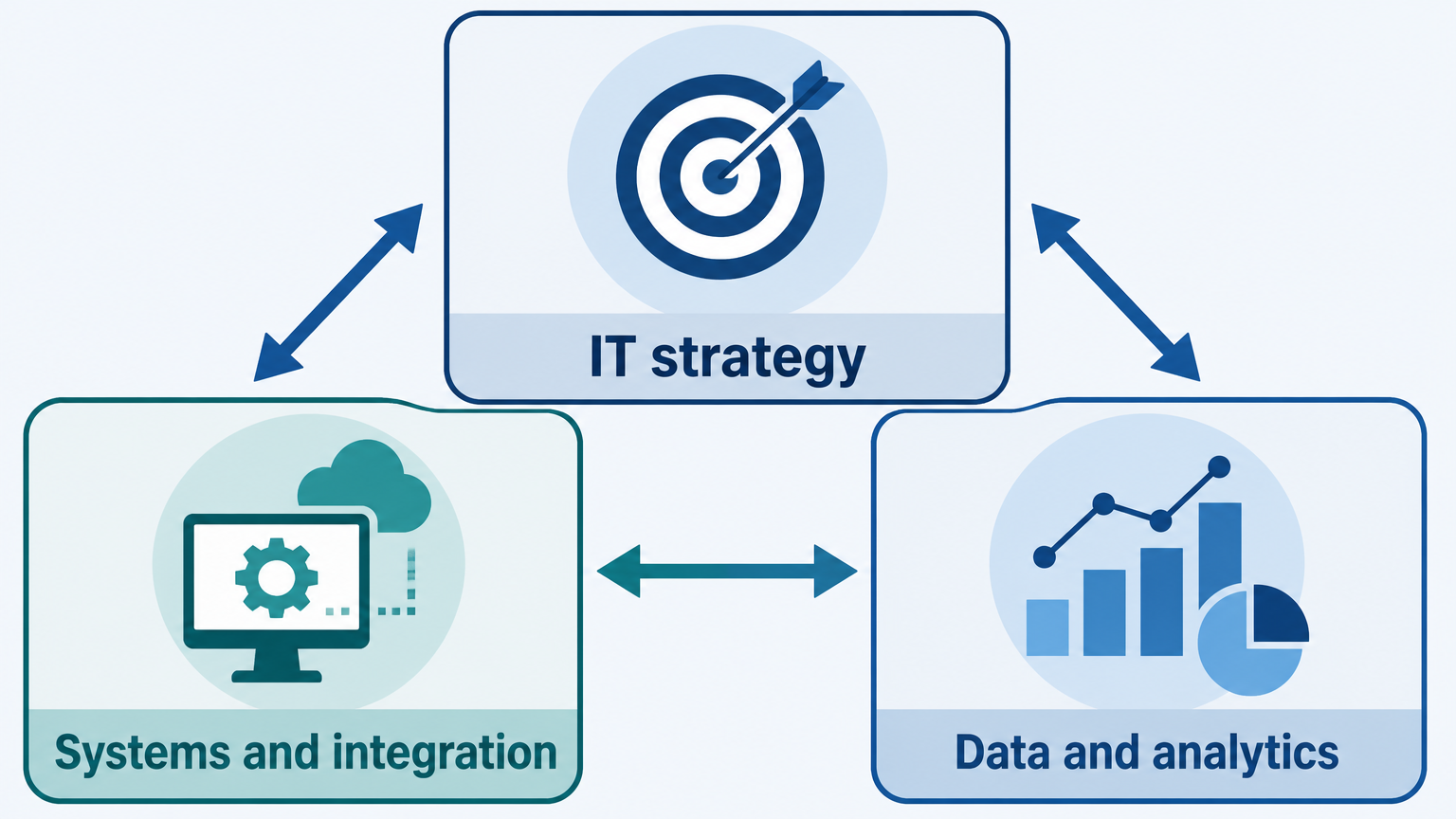 The term “healthcare IT consulting” can describe anything from a two-week technical assessment to a multiyear transformation program. Before hiring a firm, determine whether you need advice, implementation, or both. A strategy-only engagement can produce a sound roadmap, but it will not help if your team lacks the capacity to execute it.
A useful scope connects each service to a concrete decision or deliverable. “Cloud consulting” is too broad. “Assess whether the patient portal can move to a cloud architecture while preserving integration, regional data handling, backup, and access-control requirements” gives the consultant a question that can be answered and tested.
IT strategy and technology planning
IT strategy work translates organizational priorities into a sequence of technology investments. It usually begins with the current environment: applications, integrations, infrastructure, vendors, contracts, staffing, data flows, security controls, and known operational pain points.
The consultant then evaluates the desired future state. If a provider wants to expand virtual care, for example, the roadmap may need to account for patient registration, eligibility verification, consent, video services, clinician scheduling, clinical documentation, e-prescribing, payment, and follow-up communication. Treating telehealth as a single video feature would overlook most of the operational system.
Typical deliverables include:
- A current-state application and integration inventory
- A future-state architecture
- A prioritized technology roadmap
- Buy-versus-build recommendations
- Preliminary cost and resource assumptions
- Vendor and platform evaluation criteria
- Security and compliance requirements
- Governance and ownership recommendations
- Risk, dependency, and sequencing documentation
Prioritization should be more rigorous than labeling projects high, medium, or low. A consultant might score initiatives against patient impact, staff time saved, revenue implications, regulatory urgency, implementation effort, integration risk, and organizational readiness. The scoring model does not make the decision automatically, but it shows why a scheduling integration should precede a new patient engagement application or why identity management must be addressed before multiple portals are consolidated.
Systems, software, and integration consulting
Many healthcare technology problems sit between systems rather than inside a single application. Patient information may need to move among an EHR, laboratory system, imaging platform, billing system, CRM, scheduling tool, and patient portal. Each interface creates questions about format, identifiers, timing, retries, error handling, and responsibility for correcting failed transactions.
Integration consulting maps these data flows and recommends how they should be implemented. The work may involve HL7 v2, FHIR, DICOM, X12, REST APIs, webhooks, integration engines, or vendor-specific interfaces. The appropriate method depends on what the source and destination systems support, whether information must arrive in real time, and how failures will be monitored.
Software consulting also helps you choose between commercial products and custom development. A configurable platform is often preferable for standardized functions such as payroll or basic ticket management. Custom healthcare software becomes more defensible when your workflow differentiates the organization, commercial tools require extensive workarounds, or the product itself is central to the business model. Teams that reach this point may need a healthcare software development company capable of carrying the architecture into implementation.
The consultant should make integration limitations explicit before development begins. If an EHR vendor restricts API access, requires additional licensing, or offers only batch exports for certain data, the proposed user experience may not be achievable as designed. Discovering that limitation during technical due diligence is far less disruptive than finding it during acceptance testing.
Data and analytics consulting
Healthcare organizations often possess large amounts of data without having reliable decision support. The problem is rarely solved by adding a visualization layer alone. If departments define an “active patient,” “completed appointment,” or “readmission” differently, a polished dashboard can make inconsistent calculations appear authoritative.
Data consulting begins with sources, definitions, ownership, lineage, and quality. Consultants may assess how records are matched across systems, whether timestamps use consistent time zones, how canceled encounters are represented, and which system is authoritative for demographic or financial fields. They should also identify where spreadsheet transformations or manual corrections alter the data before it reaches leadership.
The technical recommendations might include a warehouse or lakehouse, an analytics model, data quality controls, master data management, and role-based reporting. Deliverables should define refresh frequency, validation responsibilities, access policies, and the process for changing metric definitions. A report used for daily operational staffing has different latency and reliability requirements from a retrospective quarterly analysis.
AI introduces additional requirements. An AI feature that summarizes clinical documents, classifies referrals, or answers questions across internal policies needs controlled data access, evaluation criteria, traceability, and human review. The engagement should define false-positive and false-negative consequences, not simply whether a model produces impressive demonstrations. If the feature uses generative AI, the design must also address prompt injection, unsupported responses, retention by external providers, model changes, and the treatment of sensitive inputs.
Common Healthcare IT Challenges Consulting Can Address
Healthcare IT projects rarely fail because nobody can write code or configure software. More often, teams disagree about the workflow, underestimate integration constraints, fail to assign data ownership, or proceed without a realistic adoption plan.
Consulting creates a structured place to resolve those issues before they become expensive implementation problems. The consultant’s role is not to eliminate disagreement. It is to make trade-offs visible, identify who has decision authority, and connect each choice to operational and technical consequences.
Aligning technology with organizational priorities
A request for a new tool often represents a deeper goal. A chief operating officer may ask for automation because intake takes too long. Clinicians may ask for another application because relevant information is hard to locate. A founder may request an AI assistant because competitors advertise one.
A good consultant works backward from the expected outcome. If the objective is faster referral processing, the assessment should measure where referrals arrive, what information is commonly missing, who reviews them, how urgency is determined, and how patients are contacted. Only then should the team decide whether it needs OCR, rules-based routing, an AI classifier, EHR integration, or a simpler form redesign.
This prevents technology from becoming a substitute for process ownership. Automating an inconsistent workflow can increase throughput while making errors harder to detect. In healthcare, that can affect patient communication, clinical review, billing, and privacy at the same time.
Alignment also requires measurable acceptance criteria. “Improve efficiency” is not testable. “Remove duplicate demographic entry from intake and reduce the number of systems staff must access for scheduling from four to two” gives the project a specific operational target.
Evaluating software and technology options
Feature matrices are useful, but they are not sufficient for healthcare procurement. Two systems may both claim to support scheduling, APIs, and role-based access while implementing those capabilities very differently. One may expose appointment data through a standard API, while another requires a proprietary interface and an additional contract.
A consulting team can build realistic evaluation scenarios instead of relying on vendor demonstrations. For example, vendors might be asked to show how staff reschedule a multi-resource appointment, how a patient updates insurance information, how a failed interface message is detected, and how an administrator reviews access to a sensitive record. These tasks expose usability and control differences that a scripted presentation may conceal.
Technical due diligence should examine:
- Authentication and single sign-on options
- User provisioning and deprovisioning
- Role and permission granularity
- Audit logging and exportability
- Encryption and key-management arrangements
- API coverage, limits, and documentation
- Backup, recovery, and continuity provisions
- Data portability and contract-exit procedures
- Subprocessor and hosting arrangements
- Mobile and accessibility support
- Vendor support and escalation processes
Total cost should include implementation, interfaces, migration, training, support, and internal administration, not just subscription fees. A cheaper platform can become the more expensive option if every new clinic requires manual configuration or if basic reporting depends on paid professional services.
Improving coordination across systems and teams
Technology fragmentation creates organizational fragmentation. When an interface fails, the EHR team may see a source-system problem, the vendor may blame invalid data, and operations may only know that staff cannot complete their work. Without clear ownership, failures persist because each group controls only part of the path.
Consulting can define operating responsibilities as well as architecture. A useful integration plan identifies who monitors transactions, who receives alerts, who corrects data, who contacts vendors, and what severity level applies when information is delayed. This turns “the interface is down” into an incident that has an owner and response path.
Coordination is equally important during product development. Clinical stakeholders may approve workflows, security teams review controls, legal teams review data use, and engineers make architecture decisions. If these reviews happen sequentially at the end, the product may require major rework. A better model brings those perspectives into discovery and maintains a decision log throughout delivery.
For operations-heavy organizations, coordination may involve nonclinical workflows too. Field teams, call centers, billing personnel, and managers might all touch the same booking or job record. A custom system should establish one authoritative status model rather than reproducing separate spreadsheets inside a web application.
How a Healthcare IT Consulting Engagement Works
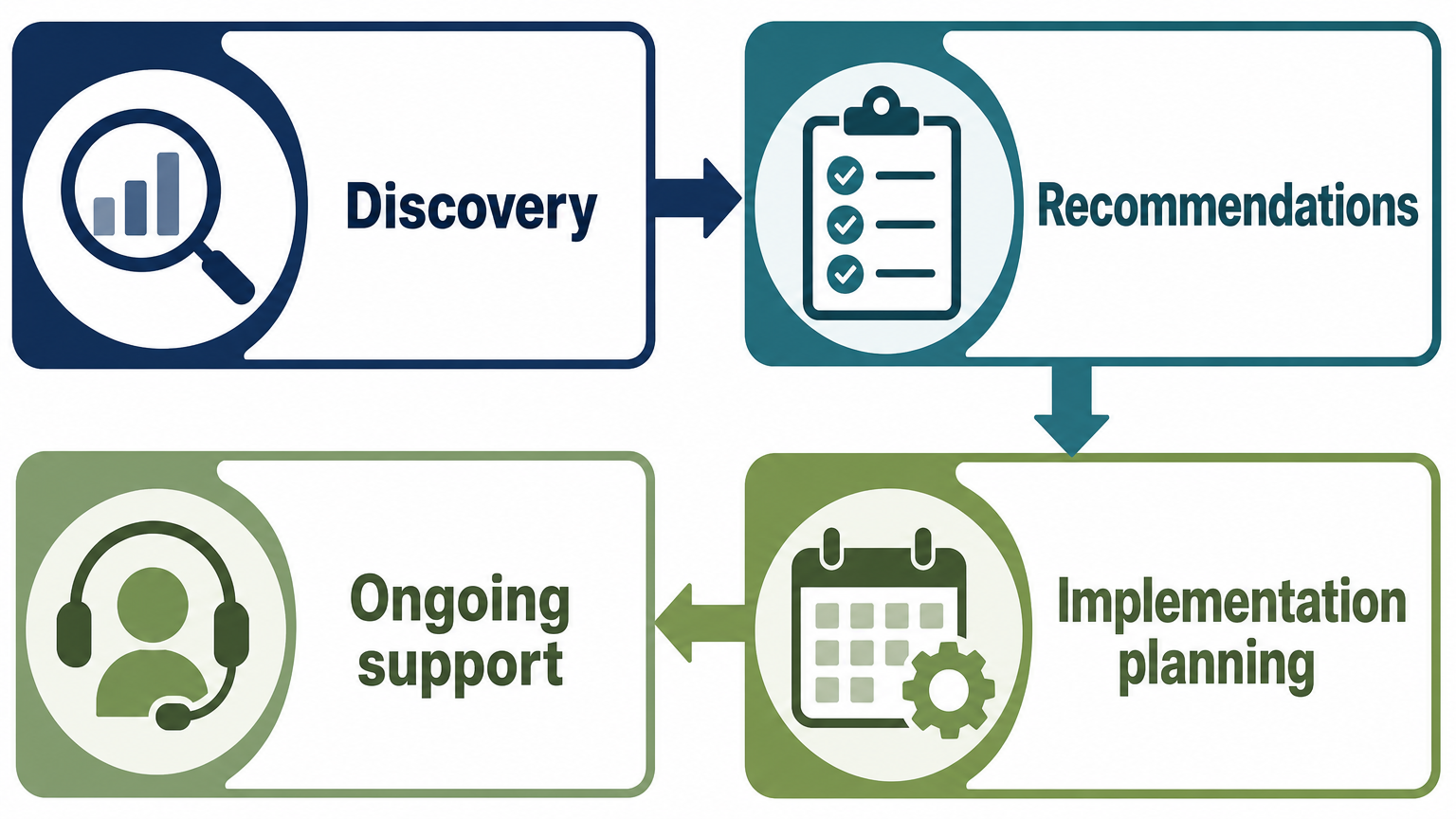 A credible proposal should explain how the consulting team will move from evidence to recommendations. Workshops alone are not a method. You should know which people will be interviewed, which artifacts will be reviewed, how findings will be validated, and what decisions the final deliverables will support.
Engagement length varies with scope, access, and organizational complexity. A focused product architecture assessment may require only several weeks, while an enterprise application rationalization or EHR transformation can take much longer. The important point is that the schedule reflects actual dependencies rather than an arbitrary package.
Discovery and current-state assessment
Discovery normally combines stakeholder interviews, workflow observation, system documentation, data-flow mapping, technical review, and artifact analysis. Relevant artifacts can include vendor contracts, architecture diagrams, interface inventories, security policies, incident records, support tickets, spreadsheets, product analytics, and prior audit findings.
The consultant should speak with people who perform the work, not only executives who sponsor it. A scheduling manager may describe the intended process, while a scheduler can show the unofficial spreadsheet used when the system cannot represent a particular appointment type. Those exceptions frequently determine whether a proposed solution will work.
Current-state findings should distinguish facts from assumptions. “The EHR cannot support this workflow” may actually mean that the current configuration does not support it or that staff were never trained on an existing feature. Validating claims with system owners and vendor documentation prevents the roadmap from being built on avoidable misconceptions.
At the end of discovery, you should receive more than meeting notes. Expect documented workflows, system boundaries, pain points, risks, constraints, and unresolved questions. These artifacts create a shared baseline for recommendation development.
Recommendations and technology roadmap
Recommendations should connect each problem to a proposed response and explain rejected alternatives. If the consultant recommends custom development, the report should show why configuration, integration, or a commercial platform would not meet the requirement. If it recommends buying, it should identify the capabilities and contract conditions that must be validated.
A practical roadmap separates foundational work from visible product features. Identity, data governance, integration infrastructure, and security improvements may need to precede a new portal or AI assistant. Although foundational projects can be less appealing to stakeholders, skipping them often creates duplicated users, inconsistent permissions, and unreliable data.
The roadmap should include sequencing, dependencies, owners, decision points, and risk. It can also divide work into horizons such as immediate remediation, near-term implementation, and longer-term modernization. Dates should remain provisional until vendor availability, staffing, procurement, and technical access are confirmed.
For a custom software initiative, recommendations may extend into product scope, architecture, delivery phases, and nonfunctional requirements. These include availability, performance, auditability, accessibility, recovery, and maintainability. Leaving them outside the roadmap means they are likely to emerge late as unplanned engineering work.
Implementation planning and ongoing support
Implementation planning converts recommendations into executable work packages. It defines governance, team roles, procurement steps, migration activities, interface development, test environments, training, rollout, and support. It should also explain how clinical or operational continuity will be maintained during the transition.
Testing needs to cover more than whether buttons work. Healthcare implementations may require interface testing, permission testing, migration reconciliation, downtime procedures, security testing, accessibility review, and user acceptance testing with realistic cases. If an AI component is involved, testing should include representative input sets, difficult edge cases, unsupported requests, and human escalation.
Ongoing support can take several forms. The consultant may advise your internal team, manage vendors, provide fractional technical leadership, or continue into design and development. Be clear about whether the same people who created the roadmap will support implementation or whether responsibility will be handed to another team.
That transition deserves its own deliverables. Architecture decisions, requirement traceability, vendor correspondence, open risks, and assumptions should be transferred in a usable format. A strategy deck without implementation-level documentation forces the delivery team to repeat discovery.
How to Evaluate Healthcare IT Consulting Companies
A polished healthcare webpage does not prove that a company can solve your specific problem. Evaluation should focus on who will perform the work, what they will produce, and whether their experience matches the technical and regulatory context of your project.
Ask candidates to explain how they would approach one difficult part of your scope. Their answer should reveal whether they recognize integration, workflow, security, and adoption dependencies. Be cautious if they move directly to a favored platform before reviewing your environment.
Relevant healthcare and technology experience
Look for experience with organizations that resemble yours in meaningful ways. A hospital system, specialty clinic, early-stage digital health company, and healthcare marketplace can all handle sensitive information, but their governance, procurement, integrations, and delivery constraints are different.
Technical experience should match the likely work. An EHR integration project requires knowledge of interface patterns and vendor limitations. A patient application requires product design, identity, privacy, accessibility, and secure software delivery. An AI feature requires data engineering and evaluation practices in addition to model integration.
Ask what the proposed team personally delivered. Firm-level experience can be misleading if the relevant specialists are not assigned to your engagement. Request named roles, expected availability, and an explanation of which work will be performed by employees, contractors, or subcontractors.
Consulting approach and deliverables
Strong firms can show sample deliverable structures with confidential information removed. You should be able to see whether their roadmaps include dependencies and owners, whether architecture documents reach sufficient detail, and whether recommendations are tied to evidence.
Clarify how decisions will be documented and approved. A project involving clinical, product, security, and engineering stakeholders can stall if every workshop reopens the same questions. Decision logs, issue registers, and defined approvers provide basic but important control.
Also ask how the consultant handles findings that change the scope. Discovery may reveal an undocumented integration, a data-quality problem, or a vendor restriction. The firm should have a process for assessing impact and presenting options rather than quietly expanding fees or forcing the original plan.
Communication, security, and implementation capabilities
Communication should match the project’s decision cadence. Weekly status reports are useful, but they do not replace rapid escalation of access problems, security concerns, or architecture blockers. Ask for the expected meeting structure, reporting format, collaboration tools, and response path for urgent issues.
Security practices should apply to the consulting engagement itself. Determine what information the team needs, how it will access your environment, where documents will be stored, and when access will be removed. Consultants should request the minimum practical access rather than shared administrator accounts or unrestricted data exports.
If the company also implements software, evaluate that capability separately. Confirm its development, testing, deployment, monitoring, and support practices. Strategy experience does not automatically imply production engineering capability, just as strong developers do not automatically provide objective technology strategy.
Questions to Ask Before Choosing a Consulting Partner
Use the selection process to test how a firm thinks, not only what it claims. Provide candidates with enough context to identify risks, but avoid prescribing the answer so tightly that every proposal becomes identical.
The following questions help distinguish a focused healthcare IT consulting approach from a generic transformation pitch:
- What decisions will your engagement enable us to make?
- What artifacts and system access do you need during discovery?
- Who will perform the work, and how much time will each person contribute?
- How will you validate workflows with frontline users?
- What deliverables will we own at the end?
- How do you separate assumptions, confirmed findings, and recommendations?
- How will security and privacy requirements affect the engagement?
- How do you identify integration constraints before recommending software?
- Can you support procurement, implementation, or development after strategy?
- How will you measure whether the implemented change achieved its outcome?
Scope, timeline, and expected outcomes
Ask the firm to define what is explicitly outside scope. If your engagement covers patient intake but not identity management, data migration, or EHR interface development, those exclusions can materially affect the recommendation. Clear boundaries make proposals easier to compare.
Timelines should identify client-side dependencies. Access approvals, contract reviews, stakeholder availability, and vendor responses can all delay assessment work. A credible plan states what your team must provide and what happens if key information is unavailable.
Expected outcomes should be decisions or operational results, not just activities. “Conduct six workshops” describes effort. “Select an integration approach and produce an implementation-ready scope for referral automation” describes value.
Experience with similar healthcare organizations
Ask for examples that match your project’s risk and delivery model, while respecting client confidentiality. The most useful discussion covers the initial constraint, alternatives considered, implementation challenge, and lesson learned. A logo list provides far less information.
Probe for experience with imperfect conditions. Real healthcare environments contain legacy systems, incomplete documentation, competing priorities, and vendors with limited APIs. A partner that has only built isolated prototypes may struggle when the work reaches identity, migration, production support, or organizational adoption.
Finally, ask candidates to identify the largest uncertainty in your proposed project. A thoughtful answer might point to API access, patient matching, source-data quality, clinical validation, or product ownership. A firm that claims certainty before discovery is offering reassurance rather than analysis.
Frequently Asked Questions
How much does healthcare IT consulting cost?
Pricing depends on scope, team composition, duration, and whether the engagement includes implementation. Compare proposals by deliverables, assigned specialists, assumptions, and exclusions rather than hourly rates alone. A low-cost assessment that omits integration analysis can shift substantially more cost into development.
Can a consultant guarantee that software is HIPAA compliant?
No consultant can guarantee compliance based on software features alone. HIPAA obligations depend on how an organization uses the system, its role, contracts, policies, safeguards, access management, and operating practices. A consultant can design relevant controls, document requirements, identify gaps, and support risk analysis.
Should we hire a consultant before selecting an EHR or software vendor?
Hiring one before selection is useful when requirements span several departments, integrations are complex, or the contract will be difficult to reverse. Independent requirements and evaluation scenarios reduce the risk of choosing based on a demonstration that does not reflect daily workflows.
Can the same company provide strategy and software development?
Yes, and continuity can reduce handoff loss between roadmap and implementation. However, ask how the company avoids automatically recommending custom development when configuration or a commercial product would be more appropriate. The buy-versus-build rationale should remain visible and evidence-based.
What should we prepare for the first consulting workshop?
Prepare your business objectives, known pain points, system list, key vendors, major contracts, workflow documents, security constraints, and current project backlog. Also identify frontline staff who can demonstrate how work actually happens. One real referral, scheduling, or reporting workflow is usually more informative than a 50-slide overview.
What is the first practical step before requesting proposals?
Write down three things: the decision you need to make, the operational outcome you expect, and the deadline driving it. Then list the systems and stakeholders that affect that decision. If you cannot define those items yet, scope the first engagement as a current-state assessment rather than asking vendors to price an undefined implementation.
Ready to build the software behind your product?
Book a discovery call