
Custom Software Development for Startups: A Practical Guide to Choosing a Development Partner
 Hamza Imran··24 min read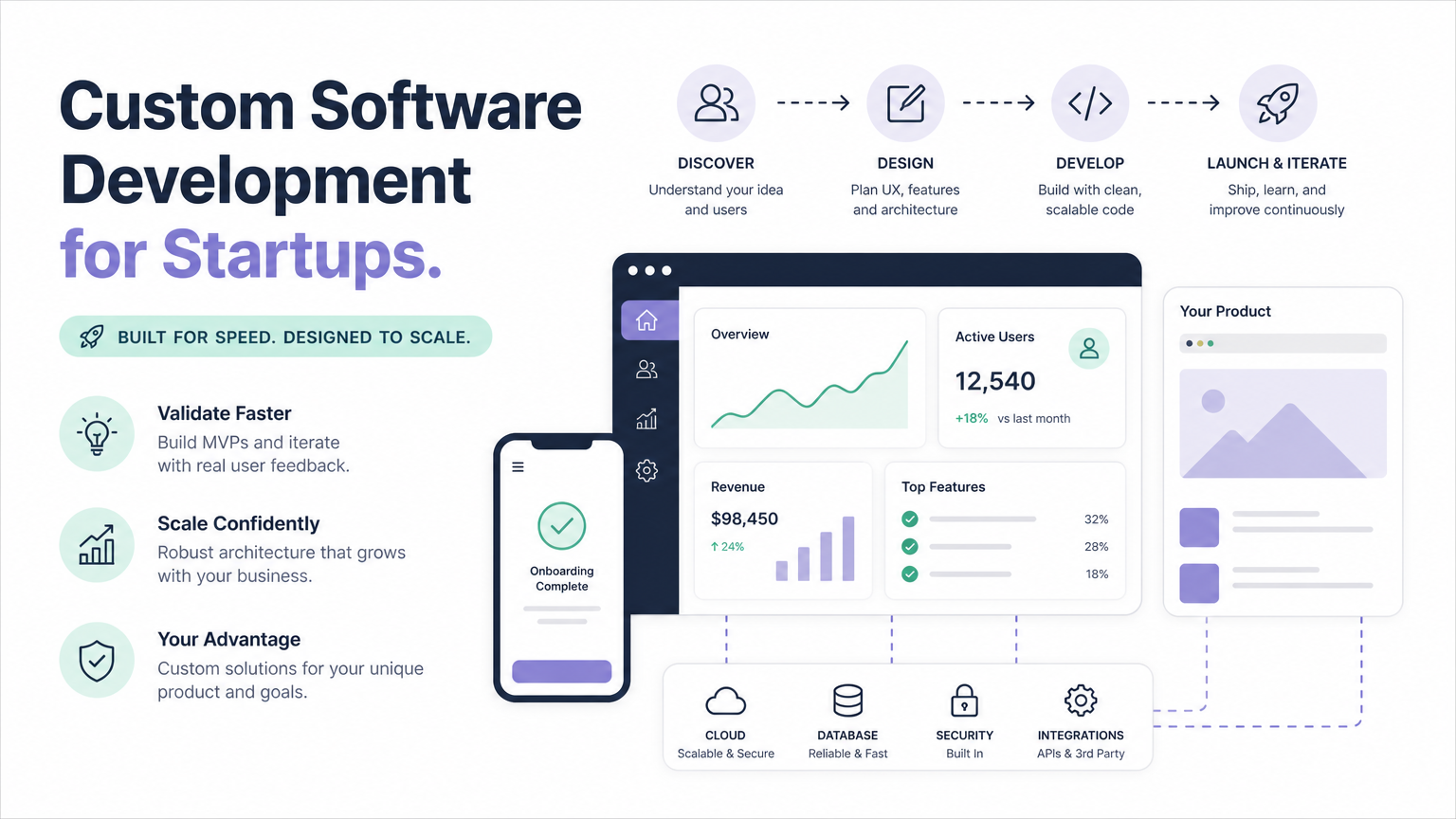
You have customer interest, a spreadsheet full of requirements, and several agencies promising they can ship your product. One proposal recommends a four-month build. Another suggests launching in six weeks. A third costs twice as much because it includes discovery, security planning, automated testing, and post-launch support that the cheaper proposals barely mention.
The difficult part is not finding someone who can write code. It is determining what should be built, which risks must be addressed before launch, and whether a prospective partner can turn an early-stage concept into dependable software without consuming your runway.
That challenge becomes more consequential in healthcare, artificial intelligence, and operations-heavy businesses. A patient application may need access controls, audit logs, consent handling, and secure integrations. An AI feature introduces model accuracy, cost, latency, and data governance questions. A field-service platform must continue working when technicians lose connectivity or enter incomplete information.
This guide explains how to commission custom software development for startups, from deciding whether a build is justified to comparing proposals, writing requirements, controlling cost, and preparing for launch.
When Custom Software Development Makes Sense for a Startup
Custom development is justified when your differentiator cannot be assembled reliably from standard products. It is not automatically the right choice simply because an existing tool feels inconvenient. Building software creates an asset, but it also creates ongoing responsibilities for hosting, security, maintenance, user support, and product decisions.
The practical question is whether owning the workflow, data model, or customer experience creates enough value to justify those responsibilities.
Signals That an Off-the-Shelf Tool Is Not Enough
Start by documenting where existing software actually fails. “We dislike the interface” is a weak reason to invest in a custom platform. “Our coordinators re-enter every booking into three systems, creating billing errors and adding 20 minutes of administration per job” is a measurable product problem.
Common signals include:
- Employees repeatedly transferring data between spreadsheets, email, and industry systems
- Customers abandoning a workflow because existing software requires unnecessary steps
- A core process depending on rules that configurable SaaS products cannot represent
- Multiple teams maintaining conflicting versions of the same information
- Revenue being constrained by manual scheduling, approval, or reporting work
- A required integration being unavailable or too limited
- Compliance or data-governance requirements that a vendor cannot contractually support
- An AI capability requiring proprietary context, evaluation, or human review
Consider a home healthcare startup coordinating visits. A generic booking platform may support appointment times and reminders, but not clinician credentials, service eligibility, geographic coverage, recurring care plans, or escalation when a shift is unfilled. If employees handle those rules manually, the limitation affects capacity and patient safety rather than convenience.
Custom software does not have to replace every commercial system. A startup can build the differentiated workflow while retaining Stripe for payments, Auth0 or another identity provider for authentication, and a suitable CRM for sales. This reduces the amount of undifferentiated infrastructure your team must maintain.
When to Validate Before Commissioning a Full Build
A full build is premature when the largest uncertainty concerns demand rather than technical feasibility. If you do not know whether clinic administrators will change their referral workflow, polished software will not answer the question more effectively than a prototype and a structured pilot.
Validation can take several forms. A clickable Figma prototype can test navigation and terminology. A “concierge” pilot can deliver the proposed service manually while customers interact with a lightweight portal. No-code tools such as Airtable, Retool, or Bubble can test an internal workflow, provided you treat them as experiments rather than assume they will become the final architecture.
Define what the validation must prove. Instead of asking whether users “like” a prototype, measure whether they can complete a task without assistance, whether a buyer will sign a letter of intent, or whether an operator saves enough time to justify adoption. For an AI documentation assistant, test output quality against a representative set of records and have qualified users score factual accuracy, omissions, and unsafe recommendations.
Validation should also expose exceptional cases. The standard booking path is rarely what makes operations software expensive. Complexity appears when a customer reschedules after dispatch, a clinician loses authorization, a payment fails, two records represent the same patient, or an AI response lacks enough evidence. Discovering those cases before implementation gives you a more credible scope and estimate.
How to Choose a Custom Software Development Partner
Agency selection should test how a team reasons, not how confidently it presents. A polished portfolio proves that software was launched, but it does not reveal who defined the architecture, whether the client supplied the designs, or how the team handled production incidents.
Ask prospective partners to explain their working model in operational terms. You need to know who will make decisions, who will write and review code, how progress will be demonstrated, and what happens when the original estimate meets new information.
Capabilities to Evaluate
Evaluate product discovery, user experience, engineering, quality assurance, DevOps, security, and project leadership separately. Small agencies may have individuals covering multiple areas, which can work well, but every responsibility should still have a named owner. “Our developers handle testing” is not sufficient unless the team can explain its test strategy and release controls.
Technical experience should match the risky parts of your product. A healthcare team should understand role-based access, auditability, protected health information, vendor agreements, and integration constraints. Teams serving US and EU users must also distinguish HIPAA obligations from GDPR responsibilities rather than treating “compliance” as one universal checklist. This comparison of HIPAA and GDPR for health software covers important differences in scope, legal roles, and architecture.
For AI functionality, look beyond model API experience. A capable partner should discuss retrieval quality, prompt and model versioning, evaluations, fallback behavior, observability, and the cost of running the feature at expected usage. If you are specifically looking to hire AI developers, evaluate whether they can integrate AI into your existing permissions and data boundaries rather than creating a disconnected demonstration.
You should also examine ownership and continuity. Confirm that your company will own the source code, designs, documentation, infrastructure accounts, and relevant intellectual property. Repositories, cloud environments, analytics accounts, and app-store listings should normally be under your organization’s control, with the agency receiving appropriate access. Ask specifically for an intellectual-property assignment clause that transfers rights as work is created rather than only on final payment, a source-code escrow or equivalent continuity provision in case the agency is ever unable to continue, and a mutual non-disclosure agreement covering both your product information and any pre-existing components the agency contributes.
Questions to Ask During Agency Selection
Give every shortlisted partner the same product scenario and ask how they would approach it. Comparable inputs make the differences between proposals easier to identify. Open-ended questions reveal more than requests for yes-or-no confirmations.
Useful questions include:
- What would you validate before beginning full implementation?
- Which assumptions make this estimate unstable?
- What do you recommend excluding from the first release?
- Who will work on the project, and how much of their time is allocated?
- How are architecture, code, and security decisions reviewed?
- How frequently will we see working software?
- What testing will be automated, and what will remain manual?
- How do you manage scope changes and estimate their consequences?
- What access, documentation, and training do we receive at handover?
- How do you respond to critical production defects?
Ask for an example of a project where the team changed its recommendation after discovery. Strong partners can describe an assumption that proved wrong, how they identified it, and how the roadmap changed. A team that claims every previous engagement followed the original plan exactly may be concealing change or failing to investigate deeply.
References are most useful when your questions are specific. Ask former clients whether senior people remained involved after the sale, whether invoices matched the agreed commercial model, and how the agency behaved when deadlines were threatened. The response to a difficult release tells you more than a general satisfaction rating.
Comparing Engagement Models: Fixed Price, Time and Materials, and Dedicated Team
The commercial structure of an engagement determines who absorbs the risk when the product definition shifts, and most proposals default to one of three models.
- Fixed price ties a defined set of deliverables to a set price. It suits a small, well-specified scope, such as an isolated integration or a single feature, where requirements are unlikely to change. Applied to an early-stage product with real discovery risk, it pushes the vendor to defend the original scope rather than adapt to what discovery reveals, which is why fixed-price proposals for uncertain products often quietly exclude testing, monitoring, or documentation to protect margin.
- Time and materials bills for hours worked against an agreed rate and estimate. It suits products where scope will legitimately evolve, but it shifts budget risk to you, so it only works well alongside disciplined estimation, a visible backlog, and frequent demonstrations of working software, not open-ended billing without checkpoints.
- A dedicated team allocates named people to your product for a period, functioning as an extension of your own team. It suits a sustained roadmap beyond a single release, where continuity and accumulated product knowledge matter more than per-feature pricing, but it requires enough of your own product management capacity to direct the team.
Match the model to the stage of your product, not to whichever number looks smallest on a proposal. A first release with genuine discovery risk is usually better served by time and materials with a capped initial phase than by a fixed price that quietly narrows in scope once the contract is signed.
Warning Signs in Proposals
Be cautious of fixed estimates produced from a one-page description. Fixed pricing can work for bounded, well-defined deliverables, but a complex product estimate should expose assumptions, exclusions, dependencies, and uncertainty. Otherwise, the omitted detail often reappears as change requests.
A credible proposal identifies deliverables by phase and connects them to outcomes. Discovery might produce validated workflows, wireframes, architecture decisions, a prioritized backlog, and an updated release estimate. “Discovery workshop: 40 hours” says what will be charged, not what you will receive.
Watch for proposals that include only feature development. Production software also requires environments, deployment automation, error monitoring, backups, analytics, documentation, and a release process. If those items are absent, ask whether they are excluded or merely hidden inside an engineering rate.
Other warning signs include full payment upfront, no access to the delivery team, ambiguous intellectual-property terms, and reliance on one developer with no review process. Guarantees of “HIPAA certification” should also prompt scrutiny because HIPAA does not provide a universal government certification for software products. A partner should instead identify applicable safeguards, contractual responsibilities, and the evidence needed to support your compliance program.
The Custom Software Development Process for Startups
The development process should reduce uncertainty in stages. Starting with every conceivable feature usually locks assumptions into code before users, integrations, and business rules have been examined.
A useful process moves from problem definition to workflow design, technical planning, incremental implementation, verification, and controlled release. Each stage should generate decisions or working artifacts, not simply meetings.
Discovery and Product Definition
Discovery translates the founder’s vision into a shared model of users, workflows, constraints, and risks. Participants may include founders, product owners, operational employees, clinicians, compliance advisers, and representatives of systems that must be integrated. The right group depends on who understands the exceptions that do not appear in a pitch deck.
The team should map current and proposed workflows. For each workflow, identify the initiating event, user roles, required information, business rules, system actions, failure states, and completion condition. A booking workflow might include eligibility checks, staff assignment, reminders, cancellation rules, payment status, and manual override permissions.
Discovery must separate known facts from assumptions. Mark uncertain integration capabilities, expected transaction volume, legal interpretations, AI quality thresholds, and user behavior as items requiring validation. This makes risk visible instead of embedding it silently into the estimate.
The output should establish a product boundary. It should explain who the first release serves, what problem it solves, what it deliberately does not handle, and which result would justify continued investment.
Requirements, Scope, and Roadmap
Requirements describe necessary behavior, while scope defines what the current engagement will deliver. Confusing the two leads teams to treat every future requirement as a launch dependency. A platform may eventually support five user roles and multiple countries, while its first release serves one market and two roles.
Prioritize complete workflows rather than isolated screens. A thin but functional release might let a customer request a service, let an operator assign it, notify the provider, and record completion. Building an elaborate customer dashboard without the assignment and exception-handling workflow produces something attractive but unusable.
A roadmap should make dependencies explicit. Authentication and permissions may precede access to patient records. A scheduling engine may require location, availability, credential, and service-duration data before optimization is meaningful. An AI assistant may require a secure document ingestion pipeline and evaluation set before a chat interface deserves significant investment.
Use priority labels carefully. If 90 percent of the backlog is “must have,” the labels are not helping. Force decisions by defining the consequence of omission: blocked launch, manual workaround, reduced convenience, or deferred revenue opportunity.
Picking a Technology Stack a Small Team Can Actually Support
For most early-stage products, the technology stack matters less than whether your team, in-house or agency, can hire for it, debug it under pressure, and evolve it without a rewrite. Optimize for a stack with a deep hiring pool, mature tooling, and predictable hosting costs rather than for what is newest.
A few defensible starting points, useful as a baseline before your partner adjusts them for your specific product:
- A standard web application or internal operations tool: a TypeScript-based full-stack framework such as Next.js, PostgreSQL as the primary database, and Redis for caching or background job queues.
- A cross-platform mobile app: React Native or Flutter, backed by the same web API rather than duplicating business logic per platform, unless a specific feature genuinely requires native device APIs.
- An AI-assisted feature: the application stack above, plus a vector store for retrieval, and a clear boundary between deterministic application logic and the model-calling layer so the AI component can be evaluated and replaced independently.
None of these choices should be permanent. Ask your partner what would force a rewrite, such as a database engine change or a framework migration, versus what can be swapped later with contained effort, such as a caching layer, a queue provider, or a single third-party integration. Startups lose the most time when they discover the difference after the fact.
Design, Development, Testing, and Launch
Design should resolve workflow questions before developers reproduce them in code. Low-fidelity wireframes are useful for testing sequence and information hierarchy. Higher-fidelity designs can then define responsive behavior, component states, accessibility needs, and content.
Development should proceed in small, demonstrable increments. Weekly or biweekly reviews let stakeholders inspect working software and catch misunderstandings while they are still inexpensive. Progress should be measured by accepted functionality, not code written or tickets marked “in progress.”
Testing needs several layers. Unit tests protect important business rules, integration tests verify boundaries between services, and end-to-end tests cover critical user journeys. Manual exploratory testing remains valuable for unusual sequences, confusing content, device behavior, and conditions the automated suite does not anticipate.
Launch should be treated as a controlled operational event. Prepare production access, monitoring, backups, support responsibilities, migration checks, rollback procedures, and user communication. A limited pilot with a known customer group can expose workflow and data issues before marketing sends hundreds of users into the system.
What to Include in a Software Development Requirements Document
A requirements document should enable designers, engineers, testers, and stakeholders to reach the same interpretation of the product. It does not need to predict every detail before work begins, but it must be precise enough to expose disagreements.
Treat it as a maintained decision record rather than a document approved once and forgotten. Requirements will change as users respond, integrations are investigated, and technical constraints become clearer.
User and Business Requirements
Start with user roles and their goals. “The system needs scheduling” is not testable. “An operations coordinator can assign an eligible provider to an unfilled visit and see conflicts before confirming” identifies the actor, action, rule, and expected feedback.
Document business rules separately from interface preferences. Include who can view or modify each category of data, which states an item can enter, who may override automated decisions, and which events require notifications. For regulated workflows, identify where consent, retention, auditability, or professional review may apply.
Include negative and exceptional scenarios. State what should happen if an integration is unavailable, a user enters duplicate information, an appointment crosses time zones, or an uploaded document contains an unsupported format. These paths often determine whether the finished product can survive real operations.
Technical Requirements and Integrations
Technical requirements should cover supported platforms, performance expectations, availability needs, environments, logging, backups, security controls, and deployment responsibilities. Avoid selecting technologies solely because they are fashionable. Architecture should follow the product’s scale, team capabilities, integration landscape, and risk profile.
For each integration, document the system owner, interface type, available documentation, authentication method, rate limits, test environment, data mapping, and failure behavior. “Integrate with the EHR” is not a usable requirement because EHR products, enabled interfaces, vendor approval processes, and customer configurations vary.
Data requirements deserve a dedicated inventory. Identify what is collected, why it is required, where it originates, where it is stored, who can access it, and when it should be deleted or anonymized. This is especially important when AI vendors, analytics services, support tools, or cloud subprocessors could receive sensitive information.
Acceptance Criteria and Success Metrics
Acceptance criteria define when a requirement is complete. A useful format describes initial conditions, user action, and observable result. For example: “Given a provider is already assigned to an overlapping visit, when a coordinator attempts another assignment, the system displays the conflict and prevents confirmation unless an authorized manager overrides it.”
Include criteria for permissions and failure states, not only the happy path. Test what an unauthorized user sees, how an API timeout is communicated, whether retries create duplicate records, and whether important activity appears in an audit trail.
Product success metrics operate at a higher level. An operations platform might measure the time required to schedule a job, the percentage of jobs needing manual correction, or completion without staff assistance. An AI feature might track qualified-user acceptance, citation coverage, escalation frequency, latency, and cost per completed task.
Do not use adoption alone as proof of value when users are required to use the product. If every employee must log in, login volume says little. Measure whether the new system reduces re-entry, shortens a workflow, prevents errors, or enables a volume the previous process could not handle.
How Much Does Custom Software Development Cost?
There is no responsible price for “an app” without defining its workflows, integrations, quality expectations, and release boundary. A five-screen prototype and a five-screen clinical application may look similar in a presentation while requiring radically different work behind the interface.
The most useful estimate breaks the product into capabilities and states its assumptions. It should also show how uncertainty is handled rather than hiding it inside a single total.
What Affects the Estimate
Cost is driven by the number and complexity of workflows, user roles, interfaces, business rules, integrations, and nonfunctional requirements. A simple administrator-managed booking tool is different from a marketplace that calculates availability, processes payments, supports recurring services, manages cancellations, and synchronizes several calendars.
Integrations create uncertainty because your partner does not control the other system. Documentation may be incomplete, sandbox behavior may differ from production, or access may require a commercial agreement. Estimate discovery or a technical spike separately when an integration is central and poorly understood.
Security and compliance requirements add work across architecture, implementation, documentation, testing, infrastructure, and operations. They are not one line item that can be attached after development. The same applies to offline functionality, complex migration, high availability, and advanced AI evaluation.
Team composition also changes the estimate. A lower hourly rate does not guarantee a lower total if the team needs more time, produces avoidable rework, or lacks the experience to identify important risks. Compare expected deliverables, staffing, assumptions, and quality controls rather than rates alone.
How Scope and Priorities Change Pricing
A hypothetical product backlog might contain 20 requested capabilities, but only six may be necessary to complete the first valuable workflow. Removing configurable branding, advanced reporting, multi-language support, and rare administrative options could reduce effort without weakening the core proposition.
Prioritization becomes more effective when you distinguish launch blockers from manual workarounds. If staff can handle refund exceptions manually for the first 50 customers, automated refund administration may wait. If every booking requires eligibility validation, that rule belongs in the initial workflow.
Scope choices can also increase costs later. Deferring a polished dashboard is generally manageable. Deferring permission architecture or tenant separation can require extensive rework because those concerns affect the data model and almost every endpoint. Ask the partner which decisions are reversible and which become structural.
Request estimates as ranges when uncertainty is genuine. Tie the range to named variables, such as an integration investigation or unresolved workflow. An unexplained range is weak, but a range that narrows after a two-week discovery phase reflects how software planning actually works.
Ways to Control Cost Without Undermining the Product
First, reduce the number of user groups served by the initial release. Supporting one operational team well is often more valuable than creating partial experiences for administrators, partners, customers, and analysts simultaneously.
Second, use managed services for standard capabilities when they satisfy your requirements. Payments, transactional email, authentication, error tracking, and cloud storage rarely need to be invented from scratch. Evaluate vendor costs and lock-in, but do not spend startup capital rebuilding commodity infrastructure merely to claim the stack is fully custom.
Third, resolve product questions before implementation. Reviewing a wireframe is cheaper than rewriting a completed workflow. Give decision-makers deadlines and consolidate feedback so developers are not responding to contradictory comments from several stakeholders.
Finally, keep quality protections around critical paths. Cutting automated tests, code review, monitoring, or backups can make an estimate look smaller while transferring cost into production failures. Reduce feature breadth before removing the mechanisms that keep payments, patient data, scheduling, or permissions dependable.
How to Prepare for a Successful Build
A development partner can facilitate decisions, but it cannot replace the product owner. Startups lose time when nobody has authority to answer workflow questions, approve designs, or choose between competing priorities.
Preparation does not require a perfect specification. It requires accessible knowledge, responsive decision-making, and agreement about what the first release must accomplish.
What Founders Should Provide Before Kickoff
Provide the business model, target users, current workflow, known constraints, existing research, and the evidence supporting demand. Share prototypes, spreadsheets, process documents, sample reports, integration documentation, and anonymized example data where appropriate.
Identify subject-matter experts early. If software will be used by dispatchers, clinicians, billing staff, or field technicians, arrange direct access to those users rather than filtering every question through a founder. Their practical knowledge will reveal rules that leadership may not encounter.
Create a list of external dependencies and owners. Include vendor contacts, API access, legal review, branding, content, infrastructure policies, and app-store accounts. A development team cannot test an integration whose credentials arrive the day before launch.
Decisions the Product Team Should Own
Your team should own the target user, product priorities, risk tolerance, and definition of success. The partner can recommend architecture and explain trade-offs, but it should not decide which customer segment matters most or whether a manual workaround is acceptable.
Assign one product owner with authority to accept work and resolve conflicts. This does not mean one person invents every answer. It means the project has a reliable mechanism for gathering expertise and issuing a final decision.
Maintain a decision log for consequential choices. Record what was decided, why, what alternatives were rejected, and what evidence would justify revisiting the choice. This prevents recurring debates and gives new team members context that backlog tickets rarely provide.
Planning for Post-Launch Improvements
Reserve time and budget for stabilization after release. Real users will uncover confusing language, unexpected data, incomplete operational procedures, and edge cases that staged testing did not reproduce. These findings are normal, but they need prioritization rather than an uncontrolled stream of urgent requests.
Define support levels before launch. Decide who receives user reports, who can inspect production logs, what constitutes a critical issue, and how releases are approved. Confirm that monitoring covers user-facing failures and business-critical events rather than server uptime alone.
Create a post-launch measurement plan tied to the original product hypothesis. Review where users stop, which tasks trigger support, how long key workflows take, and whether manual work is actually decreasing. Schedule the first product review after enough usage has accumulated to reveal patterns, then fund the next release based on observed bottlenecks rather than the oldest items in the backlog.
Frequently Asked Questions
Should a startup hire freelancers, an agency, or an in-house team?
Freelancers can suit a tightly bounded prototype, while an agency can provide product, design, engineering, testing, and DevOps capabilities without several separate hires. An in-house team offers long-term continuity but requires sufficient runway, hiring capacity, and technical leadership. Some startups use an agency for the first release while recruiting internal owners who gradually take over.
Should we ask for a fixed-price proposal?
Fixed pricing is appropriate when deliverables, acceptance criteria, dependencies, and change procedures are well defined. For an uncertain product, use a fixed discovery phase followed by a revised estimate, or fund delivery in controlled increments. A low fixed price with vague exclusions gives you less predictability than a transparent range.
Who should own the source code and cloud accounts?
Your startup should normally own the production source code, designs, documentation, domain names, cloud subscription, app-store accounts, and third-party service accounts. The contract should state when intellectual property transfers and whether any pre-existing agency components remain separately licensed. Verify ownership operationally by checking your access rather than relying only on contract language.
How long should discovery take?
A focused product with known users and few integrations may need only several working sessions and a short documentation period. A regulated platform with multiple roles, uncertain EHR access, data migration, or AI functionality may require technical investigations and stakeholder interviews over several weeks. Judge discovery by the decisions it resolves and artifacts it produces, not by workshop hours.
Can we add HIPAA or GDPR compliance after the MVP?
Some controls can be strengthened later, but identity, permissions, data flows, auditability, retention, and vendor selection can shape the entire architecture. Retrofitting them may require changing the data model, infrastructure, integrations, and operational procedures. Identify applicable regulatory obligations before selecting vendors or loading real patient data.
What are the phases of the software development lifecycle?
Most descriptions of the software development lifecycle group work into planning, requirements, design, development, testing, deployment, and maintenance. In practice these overlap rather than proceeding strictly in sequence. The stages earlier in this guide map onto the same lifecycle: discovery covers planning and requirements, design and development happen in short iterative cycles rather than one pass, and testing and deployment continue through the maintenance period rather than ending at launch.
Can a startup build custom software without hiring a partner?
Yes, if a technical co-founder or an early in-house team can dedicate meaningful, sustained time to the product rather than treating it as a side project. The trade-off is opportunity cost: hours spent on infrastructure, testing, and operational concerns are hours not spent on the product decisions only your team can make. Many startups use an external partner for the first release specifically to reach a validated product faster, then build an in-house team once the product and its risks are better understood, an approach also covered above under staffing options.
What should we review in the first month of development?
Expect validated workflows, an agreed first-release boundary, initial designs, architecture decisions, and working increments of at least one core journey. Also review the risk register, integration access, acceptance criteria, and updated forecast. If the first month produces presentations but no resolved decisions, testable designs, or working software, ask the partner to show precisely what your next invoice is buying.
Ready to build the software behind your product?
Book a discovery call