
Custom Software Development Company: How to Choose the Right Partner
 Hamza Imran··26 min read
You may be choosing between two proposals that look similar on paper but imply very different projects. One promises a rapid launch for a fixed price. The other recommends several weeks of discovery before committing to a delivery budget. Meanwhile, your team still needs to decide whether the first release requires an EHR integration, an AI assistant, an offline field workflow, or simply a reliable replacement for spreadsheets and paper forms.
Selecting a custom software development company is not primarily a question of which agency has the most developers or the longest client list. You are choosing how product decisions will be made, how technical risk will be handled, and whether the resulting software can operate safely after launch. The right partner should help you narrow the problem, expose costly assumptions early, and build an initial release that creates evidence for the next investment.
That evaluation becomes especially important in healthcare, digital health, AI-enabled products, and operations-heavy businesses. In these environments, a working interface is only one part of the result. Security controls, data flows, integrations, auditability, deployment, documentation, and ongoing support can determine whether the product is usable at all.
What a Custom Software Development Company Does
A capable development partner does more than turn requirements into code. It helps you define what should be built, identify constraints, choose an appropriate architecture, and take responsibility for turning a product concept into operating software. Depending on the engagement, the company may provide product strategy, UX design, engineering, quality assurance, cloud infrastructure, security planning, and post-launch support.
This broader role matters because many failed builds begin with a false assumption: that the requirements are already complete. A founder may have a pitch deck and clickable prototype but no defined permission model. A healthcare team may know the clinical workflow but not how consent, audit logs, or protected health information will be managed. An operations director may understand every step of dispatching a technician while underestimating the difficulty of offline access, schedule conflicts, and accounting integration.
When custom development is a better fit than off-the-shelf software
Off-the-shelf software is usually preferable when your process is common and changing it to match the tool will not damage the business. Standard customer relationship management, accounting, payroll, and internal messaging are rarely good candidates for a ground-up build. Products such as Salesforce, HubSpot, QuickBooks, and Microsoft Teams already cover broad requirements, receive regular security updates, and have established integration ecosystems.
Custom development becomes more compelling when the workflow itself creates competitive value or cannot be represented accurately in a standard product. Consider a home healthcare provider that needs to match clinicians with visits based on credentials, territory, availability, patient needs, and payer rules. A generic booking system may handle calendars, but it is unlikely to enforce all of those constraints while maintaining an appropriate patient record and escalation process.
The same reasoning applies to manual operational systems. If staff repeatedly copy information from web forms into spreadsheets, re-enter it in an accounting tool, and send status updates by text, the problem is not merely inconvenience. Each handoff creates a place where data can be lost, duplicated, or exposed. Custom job or booking software can centralize intake, scheduling, assignment, evidence collection, invoicing, and customer notifications around the organization’s actual workflow.
For AI features, the case for custom work often rests on product integration rather than model creation. Calling an OpenAI, Anthropic, Google, or open-source model API may be straightforward. Building a dependable feature around that call requires decisions about context retrieval, permissions, prompt management, output validation, human review, usage limits, latency, evaluation, and data retention. If you plan to hire AI developers, assess whether they can design the full feature and its safeguards, not just connect an interface to a model endpoint.
Services founders and product teams should expect
A full-service engagement should begin with product definition rather than immediate sprint execution. The team should be able to map users and workflows, challenge feature assumptions, identify dependencies, and recommend an initial release boundary. For a startup, that may mean reducing a broad marketplace concept to one transaction path and one administrator role. For an established business, it may mean selecting one branch or operational team for the first deployment.
Design should include both interface design and interaction logic. Attractive screens do not resolve what happens when two dispatchers assign the same worker, a patient withdraws consent, an integration times out, or an AI-generated recommendation lacks sufficient evidence. The partner should document empty states, errors, permissions, exceptions, and recovery paths as part of the product experience.
Engineering services commonly include frontend and backend development, database design, API development, third-party integrations, cloud configuration, automated testing, and release pipelines. In regulated products, expect security and privacy requirements to influence architecture from the start. Teams building for both US healthcare and European users should understand that HIPAA and GDPR impose different obligations rather than treating “compliance” as a single checklist. This guide to HIPAA and GDPR for healthcare software explains several of the distinctions that need to appear in technical planning.
Support after release should also be defined as a service, not assumed as a courtesy. Production software requires monitoring, dependency updates, incident handling, backups, defect resolution, and adaptation to user feedback. Ask whether these activities are included in a warranty period, offered through a support retainer, or billed from the same development budget.
How to Choose the Right Development Partner
Portfolio quality is useful, but it is not enough to establish fit. A polished case study may tell you that a company can produce a good interface while revealing little about its role in architecture, deployment, security, or product decisions. You need to investigate what the team actually delivered and how closely that work resembles the risks in your project.
The strongest evaluation process combines evidence, direct conversations, and a small amount of structured due diligence. That can include a technical discussion with the proposed lead, a review of sample documentation, reference calls where appropriate, and a paid discovery engagement before a larger commitment.
Relevant product and technical experience
Look for experience with the problem category, not necessarily an identical product. A team that has built clinical dashboards, patient applications, and EHR integrations may be well positioned for a new care coordination tool even if it has never served that exact specialty. Relevant experience should help the team anticipate consent requirements, role-based access, interoperability constraints, clinical safety concerns, and the difference between patient-facing and staff-facing workflows.
For healthcare projects, ask how the company translates regulatory obligations into system controls. Useful answers should cover areas such as access restrictions, audit events, encryption, session management, backups, incident procedures, and vendor dependencies. Be cautious when a provider markets a product as generically “HIPAA certified.” HIPAA readiness depends on technical, administrative, contractual, and operational safeguards, including how the covered entity or business associate uses the system.
A healthcare software development company should also be able to discuss integration mechanics. Connecting to an EHR through FHIR does not eliminate differences among vendor implementations, authorization models, data mappings, or workflow requirements. Ask which standards, vendors, and integration patterns the proposed team has worked with, then ask what specifically made those projects difficult.
For AI work, request evidence of evaluation practices. A convincing team should discuss test datasets, expected answer criteria, hallucination handling, source attribution, prompt versioning, model changes, and fallback behavior. Experience building a chatbot is less meaningful if the team cannot explain how it measures whether the chatbot is correct, safe, and useful.
Communication, collaboration, and delivery practices
You should know who will make day-to-day decisions before the contract begins. Ask whether you will work directly with a product manager, technical lead, designer, and engineers or communicate mainly through an account manager. Layers of coordination are not inherently bad, but they can slow clarification when product and engineering questions must pass through several people.
Inspect the proposed operating rhythm. A practical cadence may include weekly planning, short written status updates, regular demonstrations of working software, and a maintained decision log. Tools such as Jira, Linear, GitHub, Figma, Slack, and Microsoft Teams can support this process, but tool choice matters less than whether information remains visible and current.
Demonstrations should show deployed, testable functionality rather than a slide listing completed tickets. For example, if a sprint focused on patient registration, the demonstration should include validation, consent capture, failure states, and the resulting administrative record. This makes misunderstandings visible while they are still relatively inexpensive to correct.
Pay attention to how the company communicates uncertainty. An experienced partner will not promise an exact delivery date for an undefined integration or an AI feature that has not been evaluated. It should explain the unknown, propose an investigation, and show how the outcome would affect scope. Responsible qualification is more valuable than confident but unsupported certainty.
Evaluating proposals and project fit
Compare proposals by assumptions and exclusions, not just totals. One estimate may include design, automated testing, production infrastructure, and project management, while another covers engineering only. If those differences remain hidden, the cheaper proposal can become more expensive after necessary work is added.
A credible proposal should connect features to effort and identify the largest sources of uncertainty. It might state that appointment scheduling is estimated on the assumption of one location and one time zone, or that an EHR integration requires confirmed API access. These details let you understand what could change the price instead of treating the estimate as an unexplained number.
Evaluate whether the recommended team is proportionate to the project. An early validation build may need a product-oriented designer and two versatile engineers rather than a large specialist team. A clinical platform with multiple integrations may justify dedicated backend, frontend, quality assurance, DevOps, and security expertise. More people can increase capacity, but they also add coordination cost and do not automatically shorten work that has sequential dependencies.
Finally, assess commercial alignment. A provider that earns more when the scope expands should still be willing to remove low-value features. During proposal discussions, ask what the team would cut first if the budget were reduced by 20 percent. The quality of that answer reveals whether it understands your product priorities or has simply priced a list.
Start With a Software Development Discovery Phase
 Moving directly from an idea or requirements document into development feels fast because developers begin writing code immediately. In practice, unresolved product questions simply reappear during implementation, when changes affect database structures, APIs, designs, and tests. Discovery moves those decisions earlier, before the cost of changing direction increases.
Discovery can be a short, focused engagement or a multiweek phase depending on complexity. The objective is not to document every future screen. It is to create enough shared understanding to define a credible first release, identify serious risks, and make a responsible delivery plan.
Discovery goals and activities
The first goal is to establish the business outcome. “Build a booking platform” is a solution statement, not an outcome. A more useful objective might be reducing the time coordinators spend assigning jobs, allowing customers to book without calling, or testing whether clinicians will use an AI-assisted documentation feature.
The team should then map primary users, workflows, and exceptions. Interviews with staff often reveal that the documented process differs from real operations. A dispatcher may maintain a private spreadsheet because the current system does not track equipment availability. A nurse may postpone entering notes because connectivity is unreliable during home visits.
Technical discovery examines existing systems, data sources, integration access, security constraints, and deployment expectations. This can include reviewing API documentation, inspecting sample files, confirming identity providers, and identifying data that must be migrated. For AI features, discovery may include testing representative inputs against several models and defining what constitutes an acceptable response.
Prioritization should be explicit. Techniques such as impact-versus-effort mapping or must-have, should-have, could-have classification can help, but the labels need operational definitions. A feature is not a must-have because a stakeholder likes it. It is a must-have when the release cannot deliver its intended outcome, meet a contractual obligation, or operate safely without it.
Typical discovery deliverables
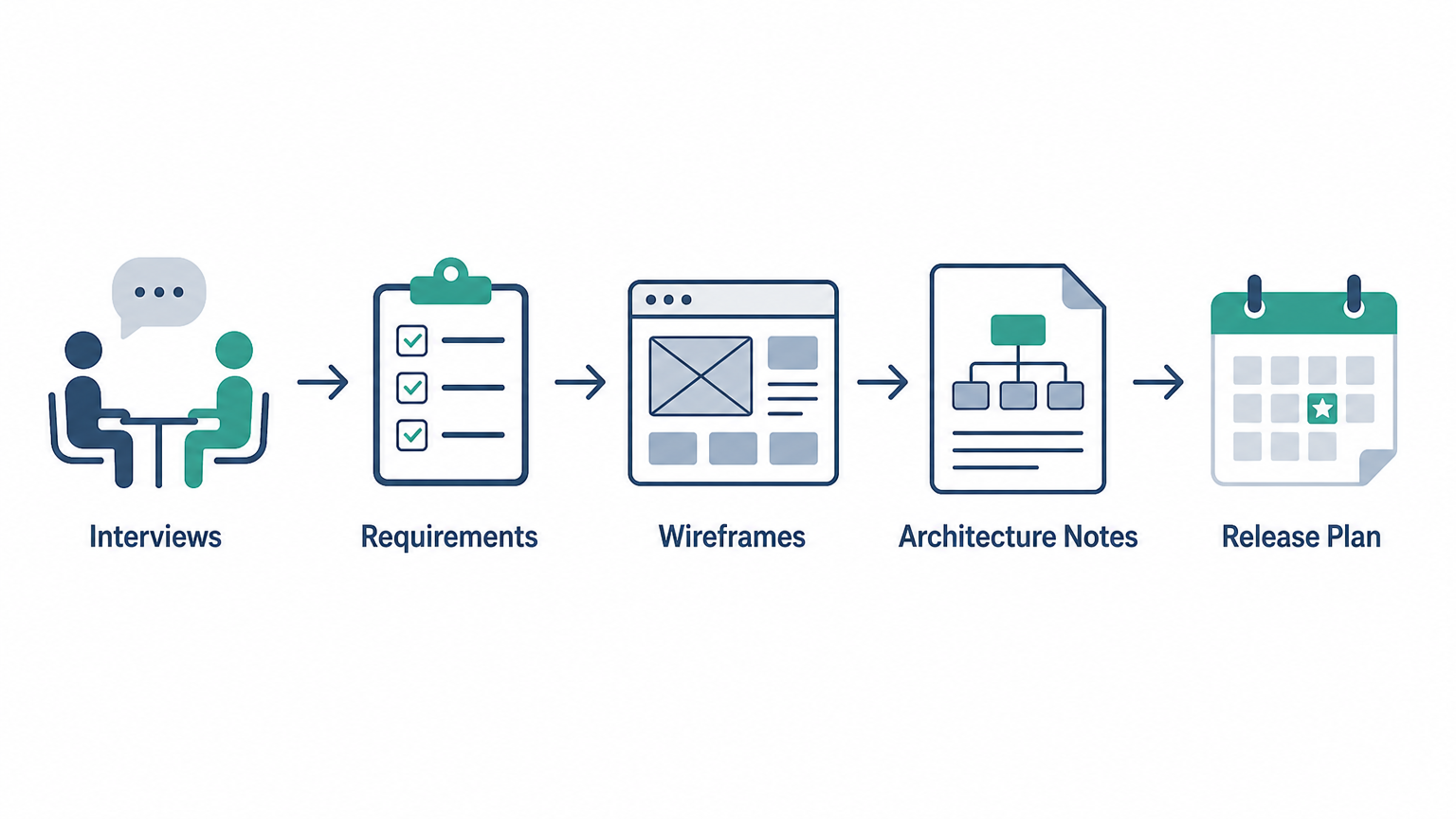
Discovery should produce artifacts that the development team can use. Common deliverables include a product brief, user roles, workflow diagrams, prioritized requirements, an initial backlog, wireframes, architecture recommendations, and a release roadmap. Regulated or sensitive systems may also require an initial data-flow diagram, threat considerations, access model, and vendor inventory.
A good backlog describes behavior and acceptance conditions rather than using labels such as “build dashboard.” It should clarify which user can view the dashboard, where the data originates, how frequently it updates, and what happens when information is unavailable. That level of detail supports estimation and testing without attempting to predetermine every implementation choice.
Technical deliverables should record decisions and alternatives. If the team recommends a modular monolith instead of microservices, the rationale may be faster initial delivery and simpler operations while the product has limited scale and one engineering team. If it recommends managed cloud services, the document should identify implications for cost, portability, access, and regulatory agreements.
Discovery should end with an updated estimate or a range tied to scope assumptions. It may also produce a phased plan, such as prototype, operational pilot, and broader rollout. The deliverables should remain useful if you choose a different company for implementation, although the team that performed discovery will naturally retain context.
How discovery reduces project uncertainty
Discovery cannot remove every unknown, especially when a product depends on user behavior or a third-party system. Its value lies in separating known work from unresolved risks. That enables you to run targeted experiments rather than embedding assumptions in the full build.
Suppose an AI assistant is expected to draft responses using internal policy documents. Before building administrative screens and user workflows, the team can test document extraction, retrieval quality, citations, and answer accuracy against representative questions. If the results are weak, you can change the source material or feature boundary before investing in a complete interface.
For an operations platform, a technical spike might test whether the accounting provider’s API supports the required invoice and payment states. For a health product, it might confirm whether the intended EHR exposes the necessary resources and authorization flow. These investigations may require several days of focused work, but they protect a much larger delivery budget from a false assumption.
Discovery also improves stakeholder alignment. When everyone can review the same workflow and release scope, disagreements become visible before they turn into change requests. A written decision that the pilot supports one clinic, two user roles, and manual data import is much harder to misinterpret than a broad instruction to “build the MVP.”
Understand Custom Software Development Costs
 A useful budget is not a single number presented without context. It is a model of team capacity, delivery time, product scope, and uncertainty. Two products with the same number of screens can have very different costs if one displays static content while the other handles complex permissions, integrations, offline synchronization, or sensitive records.
Your goal is not to force a premature guarantee. It is to understand what the estimate includes, what could change it, and how spending will be controlled as evidence emerges.
Factors that influence the budget
Team composition is one of the largest cost drivers. A project may require product management, UX design, frontend and backend engineering, quality assurance, DevOps, and specialist security or data expertise. Some roles can be fractional, especially early in the project, but removing them does not remove the work. It usually transfers that work to another person or leaves it undone.
Complexity often hides in rules and exceptions. A calendar interface may appear simple until it must account for recurring availability, travel time, qualifications, cancellations, time zones, waiting lists, and simultaneous booking attempts. Likewise, a document upload feature becomes more involved when it requires malware scanning, OCR, retention rules, granular access, and an immutable record of who viewed or changed the file.
Integrations introduce dependencies outside the development company’s control. API quality, sandbox availability, rate limits, vendor approval, incomplete documentation, and inconsistent data can all affect effort. Data migration can be equally significant, particularly when years of spreadsheet records contain duplicates, missing identifiers, and incompatible formats.
Nonfunctional requirements also affect the budget. Availability expectations, performance, accessibility, audit logging, disaster recovery, and security testing require design and implementation work even though they may not appear as visible features. They should be represented in the estimate rather than treated as finishing tasks.
How scope and priorities affect estimates
The most effective way to control cost is to narrow the release around a complete outcome. A fragmented release with half of every planned feature may be impossible to use. A narrower release can support one user group and one workflow from beginning to end, generating real feedback while postponing secondary capabilities.
Imagine a field-service platform that eventually needs customer self-booking, automated dispatch, route optimization, technician tracking, inventory, invoicing, and analytics. The first release might instead cover internal job creation, manual assignment, a technician mobile workflow, evidence capture, and job completion. It would deliver operational value without requiring every automation at once.
Prioritization should also account for reversibility. Visual refinements and notification wording are relatively easy to change. Identity architecture, data ownership, integration contracts, and tenancy models are expensive to redesign. Spend more decision-making effort on foundations that constrain future work, while avoiding infrastructure intended for a scale the product has not demonstrated.
Ask for estimates by phase or capability rather than one undifferentiated total. This gives you options if costs or findings change. You may decide to launch without advanced reporting, postpone native mobile applications in favor of a responsive web experience, or keep a human approval step until an automation proves dependable.
Questions to ask about pricing and assumptions
Clarify whether the engagement uses fixed price, time and materials, or a dedicated-team model. Fixed price can work for a tightly defined scope with stable assumptions, but the price must include a risk allowance and changes require formal handling. Time and materials is more adaptable when the product will evolve, although it requires active prioritization and transparent reporting.
Ask what each rate includes. Determine whether project management, design revisions, testing, meetings, deployment, cloud setup, and post-launch fixes are billable. Also ask who pays for hosting, model usage, SMS delivery, maps, monitoring platforms, and other third-party services.
Review payment triggers carefully. Milestones should correspond to understandable deliverables or delivery periods, not vague percentages such as “development 80 percent complete.” For iterative work, regular invoices accompanied by time reports, sprint results, and budget forecasts may provide clearer control.
Request the estimate’s assumptions and exclusions in writing. Ask what event is most likely to increase the budget, how quickly you will be notified, and who can authorize additional work. A practical proposal should make it possible to distinguish a changed requirement from correcting software that did not meet an agreed acceptance condition.
From Product Definition to End-to-End Delivery
Commissioning software does not end when the backlog is approved. Product choices continue throughout design and development because working software exposes details that documents cannot. Your partner needs a delivery system that supports these decisions without losing control of scope, quality, or security.
End-to-end responsibility should include the path to production. Code that works on a developer’s laptop is not a completed product. Deployment environments, monitoring, backups, access procedures, and operational ownership must be ready when users arrive.
Planning the initial release
Define the initial release by users, outcome, and operating boundary. A digital health pilot might support one care team and a limited patient cohort, with staff manually reviewing exceptions. An operational product might launch at one location before accounting for regional rules and multiple currencies.
Document what the release will not do. Exclusions protect the team from accidental expansion and help stakeholders plan temporary processes. If appointment reminders will be sent manually during the pilot, state that clearly rather than leaving notifications in an ambiguous future category.
Identify launch dependencies early. App store review, security assessment, data processing agreements, business associate agreements, domain configuration, integration credentials, and production cloud accounts can take coordination outside the sprint plan. Assign an owner and required date to each dependency.
The release plan should also include success signals. These may include whether users complete the target workflow, where they abandon it, which errors occur, and how much staff intervention is required. Measurements should support a product decision, not exist merely because analytics tools can collect them.
Design, development, testing, and deployment
Design and engineering should overlap enough to surface feasibility issues but not so much that developers repeatedly build unfinished concepts. Designers can work ahead on validated workflows while engineers establish architecture and implement approved components. Regular reviews keep both disciplines aligned.
Testing should happen throughout development. Automated tests are valuable for business rules, APIs, and high-risk regression paths, while exploratory testing can uncover confusing interactions and unexpected combinations. Healthcare and operational systems also need permission testing because a feature can work correctly for one role while exposing data to another.
Security work should be integrated into delivery through code review, dependency management, secret handling, environment separation, and controlled production access. Sensitive information should not be copied casually into development or testing environments. When realistic data is required, the team should have a documented method for generating, de-identifying, or tightly controlling it.
Deployment should be repeatable through a defined release pipeline. The team should know how database changes are applied, how configuration differs by environment, and how a faulty release will be rolled back or corrected. Before launch, confirm monitoring, alert recipients, backup behavior, and the procedure for reporting a production incident.
Post-launch support and iteration
The first days after launch usually reveal operational questions rather than only code defects. Users may misunderstand a status label, administrators may need a missing filter, or an external API may behave differently under production load. Plan a stabilization period with clear response ownership.
Separate defect correction from new product work. A defect is behavior that fails an agreed requirement or acceptance condition. A newly requested report or altered workflow may be valuable, but it should enter prioritization rather than being disguised as a bug.
Support arrangements should state service hours, severity definitions, target responses, and escalation channels. A system used during weekday office hours has different requirements from a patient or dispatch platform operating around the clock. Ensure that the commercial agreement reflects the actual consequence of downtime.
Iteration should be driven by observed behavior and operational evidence. Review support requests, analytics, failed workflows, manual interventions, and user interviews together. A feature requested loudly by one stakeholder may be less important than a recurring point where dozens of users cannot complete a core task.
Questions to Ask Before Signing a Contract
A contract should turn sales promises into operating rules. It needs to cover intellectual property, responsibilities, payment, confidentiality, data handling, acceptance, termination, and transition. Legal counsel should review the agreement, especially when regulated data, material business processes, or valuable product IP are involved.
Use the contract discussion to expose assumptions that may have survived the proposal stage. The answers should identify owners, processes, and deliverables rather than relying on assurances that the company “normally handles it.”
Ownership, security, and documentation
Confirm that your organization will own the custom source code, designs, and project-specific deliverables after meeting the agreed payment terms. Identify any reusable agency components, open-source packages, or licensed tools that remain subject to separate terms. You should understand whether any dependency could restrict future modification or commercial use.
Your organization should control critical production assets where practical, including cloud accounts, domains, application store accounts, analytics, and source repositories. An agency can receive appropriately limited access without being the permanent owner. This reduces transition risk if the commercial relationship ends.
Security responsibilities need explicit boundaries. Determine who configures cloud access, monitors alerts, applies dependency updates, manages encryption keys, and coordinates incident response. For healthcare products, verify which vendors may handle protected health information and whether required contractual arrangements can be executed.
Documentation should include more than a generated API reference. Request architecture diagrams, deployment instructions, environment descriptions, integration notes, data models, and operational procedures proportionate to the system. The test of documentation is whether another qualified team could maintain the product without reconstructing every decision from the source code.
Timeline, milestones, and change management
Ask what the timeline assumes about your team. Delivery may depend on stakeholder availability, content, compliance review, API credentials, or feedback within a specified period. If your decisions take two weeks instead of two days, the schedule and team allocation may change.
Milestones should describe verifiable results. “Backend complete” is difficult for a nontechnical stakeholder to evaluate. “Authorized clinic staff can create a patient record, record consent, and retrieve the resulting audit event in the staging environment” is substantially clearer.
The agreement should define how changes are proposed, estimated, approved, and recorded. Small decisions occur constantly, but changes that affect cost or schedule need a visible mechanism. Specify who in your organization is authorized to approve them so that an informal request does not become a disputed invoice.
Also determine what happens if a milestone is delayed. The contract should distinguish delays caused by the supplier, your organization, and external dependencies. A recovery conversation is more productive when both parties already understand how schedules, costs, and staffing will be adjusted.
Team structure and ongoing support
Request the planned roles, allocation, and seniority of the delivery team. Ask whether named leads will remain assigned after the sale and how substitutions are handled. If the proposal depends heavily on one architect or domain specialist, determine their actual weekly availability.
Clarify where team members are located and how working hours overlap. Distributed delivery can work well, but urgent questions should not wait an entire day because no shared communication window exists. The company should explain how handoffs, code reviews, and releases function across locations.
Ask who will maintain the system after launch and how knowledge will transfer. If you expect to hire an internal engineering team later, include repository access, documentation, infrastructure walkthroughs, and technical handover in the plan. If the development company will remain responsible, request a separate support model rather than extending the build indefinitely without service expectations.
Before signing, reduce the decision to three pieces of evidence: a scoped discovery plan, a proposal with explicit assumptions, and a contract that gives you control of the code and production assets. If a prospective partner cannot show who will make decisions, how changes affect the budget, and who responds when the first production integration fails, resolve those gaps before authorizing the first sprint.
Frequently Asked Questions
How much does custom software development typically cost?
There is no single answer, because a booking calendar with recurring availability rules costs more to build than a static content page, and integrations with an EHR or accounting API introduce risk outside the development company’s control. Instead of asking for one number, request estimates broken out by capability or phase, and ask which assumption is most likely to move the price - vendor API access, data migration quality, and scope creep are the usual culprits.
How long does a typical project take from discovery to launch?
A short discovery engagement can take one to three weeks, while multiweek discovery is common for regulated or multi-integration products. Development timelines vary even more: a narrow first release covering one workflow and one user role might ship in six to ten weeks, while a platform with several integrations and compliance requirements can run several months. Ask a prospective partner for a phased timeline tied to the same scope assumptions as the estimate, not a single end date.
Do I need a discovery phase if I already have detailed requirements?
Even a detailed requirements document usually hides unresolved decisions, since permission models, exception handling, and integration behavior rarely make it into a product brief. A short discovery pass, even a few days, can surface these before they turn into expensive mid-build changes. Skip it only when the product is narrow, non-regulated, and has no third-party integrations.
What is the difference between fixed-price and time-and-materials contracts?
A fixed-price contract sets one number for a defined scope, which works when requirements are stable and well understood, but any change usually requires a formal, often expensive, amendment. Time-and-materials bills for actual hours against a rate card, giving more flexibility to reprioritize as the product evolves, at the cost of needing active budget oversight. Dedicated-team models sit between the two, billing for a committed team’s capacity regardless of week-to-week output.
Who owns the code and infrastructure after the project ends?
Confirm in the contract, not just the sales conversation, that your organization owns the custom source code, designs, and project-specific deliverables once payment terms are met - reusable agency components or licensed third-party tools may carry separate terms. Push for your organization to hold the cloud accounts, domains, and repositories directly, with the agency granted appropriately scoped access, so you are not locked out if the relationship ends.
How do I know if a development company has real healthcare or compliance experience?
Ask for specifics rather than a badge: which access-control model they implemented, how they handled audit logging, what encryption and backup practices they used, and which EHR vendors or FHIR implementations they have actually integrated with. Be skeptical of any company marketing itself as generically HIPAA certified, since HIPAA readiness depends on administrative, technical, and contractual safeguards specific to how your organization uses the system, not a one-time certification.
Ready to build the software behind your product?
Book a discovery call