
Custom Healthcare Software Development Company for HIPAA and GDPR-Ready Solutions
 Hamza Imran··22 min read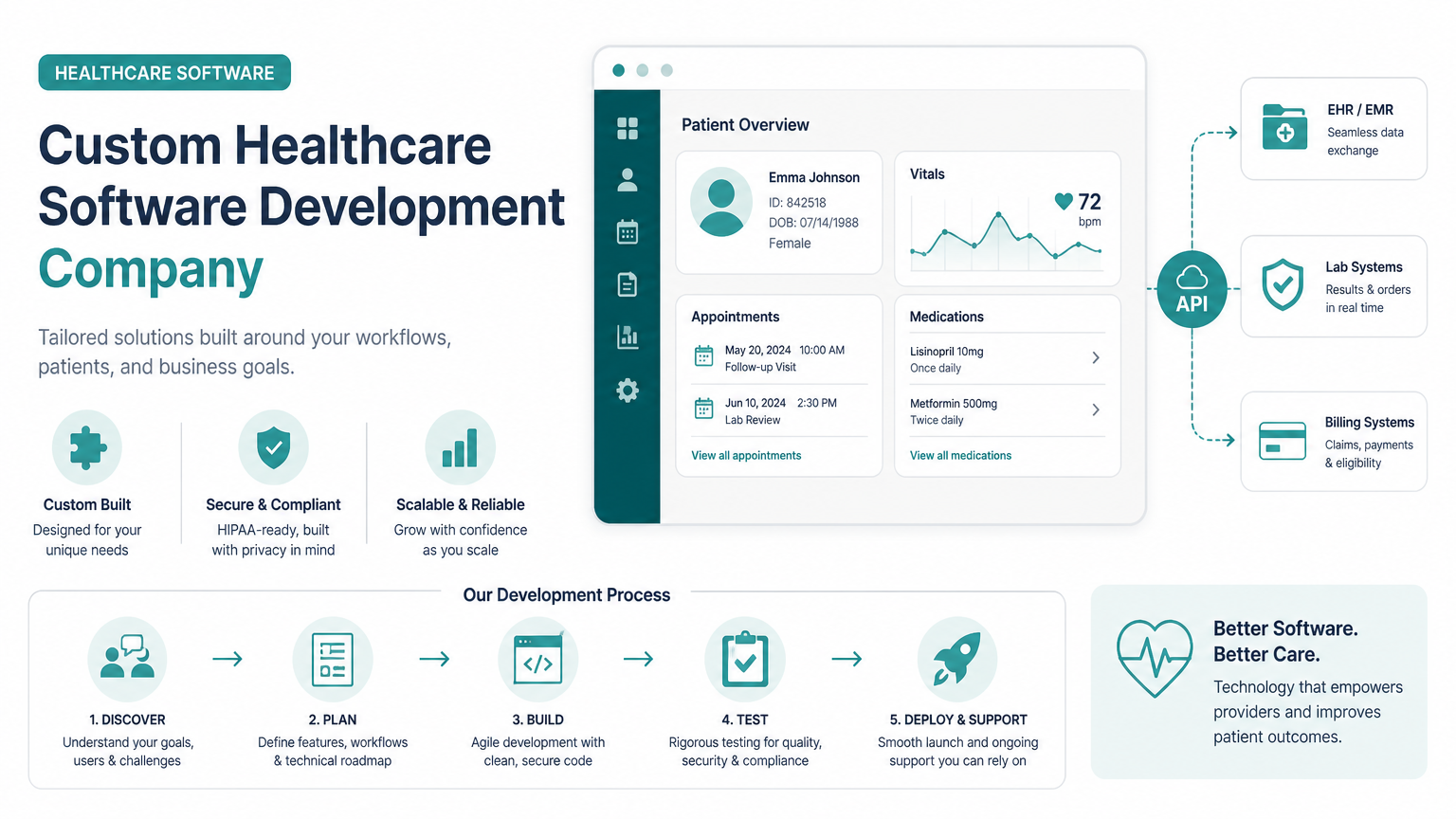
Your team may already have a scheduling platform, EHR, CRM, billing system, and several spreadsheets. Yet staff still copy patient details between screens, clinicians wait for incomplete intake forms, and operations teams reconcile conflicting records by hand. Buying another general-purpose healthcare product can add one more data silo without fixing the workflow connecting them.
A custom healthcare software development company approaches the problem differently. Instead of forcing your clinical, administrative, or digital health workflow into a predefined product, the development team designs the application, integrations, permissions, and data model around the work your organization actually performs. That can mean building a patient application, connecting an existing product to EHRs, automating a paper-heavy referral process, or adding an AI-assisted feature with appropriate human review.
Healthcare customization also carries obligations that ordinary application development does not. Architecture decisions can affect whether protected health information is exposed in logs, whether a deleted account remains in backups, whether an organization can answer a data subject request, and whether every access to a clinical record is attributable to a specific user. HIPAA and GDPR readiness therefore cannot be postponed until a security review shortly before launch.
This guide explains what custom healthcare teams can build, how HIPAA and GDPR influence the work, what a practical development engagement looks like, and how to evaluate potential partners before sharing production data or signing a long-term contract.
Why Healthcare Teams Choose Custom Software Development
Healthcare organizations rarely commission custom software simply because they want a different interface. The investment becomes reasonable when existing tools create measurable operational constraints, cannot support a differentiating product feature, or make compliance and integration unnecessarily difficult.
A provider may need to coordinate intake, eligibility checks, scheduling, clinical documentation, and billing across systems from different vendors. A digital health company may have a strong patient experience but no reliable method for sending observations into a provider’s EHR. A payer may need to replace email-based authorization work with a traceable workflow. In each case, the value of custom development comes from controlling the workflow and its connections, not from recreating software that can already be purchased.
When off-the-shelf tools are not enough
Commercial products work well when your process resembles the process their vendor designed around. Problems emerge when you need nonstandard eligibility rules, specialized clinical questionnaires, multi-party approvals, unusual appointment constraints, or a patient journey spanning several independent organizations. Configuration options may cover individual fields and notifications while leaving the underlying workflow unchanged.
Consider a specialty clinic that receives referrals by fax, manually confirms coverage, requests missing records, assigns cases by geography, and books several related appointments. A standard scheduling platform may handle the final appointment but not the preceding ten decisions. Custom software can create a referral record as soon as a document arrives, assign tasks, detect missing information, enforce status transitions, and send approved appointment data to the scheduling system.
Customization is also justified when a workflow defines the product’s competitive advantage. A digital therapeutics company should not have to reshape its intervention model around generic task-management software. Similarly, a home health operator may need dispatch logic based on credentials, travel time, continuity of care, and patient preferences rather than simple calendar availability.
The important distinction is between a genuine workflow requirement and a preference. Rebuilding commodity authentication, payment processing, or video conferencing from scratch usually adds cost and security exposure. A strong development partner identifies which capabilities should be custom, which should be configured, and which should be delegated to established platforms through secure integrations.
Use cases for providers, payers, and digital health companies
Provider organizations often need patient intake portals, referral management systems, clinical dashboards, care coordination tools, internal scheduling applications, and EHR-connected mobile experiences. The software might validate intake information before an appointment, route a high-risk response to a clinical queue, or show operational staff which referrals have exceeded an internal service target.
Payers and benefits administrators face different workflow pressures. Custom systems can support prior authorization intake, document collection, case assignment, provider communications, claims exception handling, and member service operations. These applications need explicit status models and audit histories because a single case may pass through reviewers, supervisors, clinicians, and external providers.
Digital health companies commonly require a patient-facing product plus an administrative or clinical console. Their platforms may collect symptom reports, connected-device readings, messages, consent records, and engagement events. The challenge is not merely storing this data. The application must present the right information to the right role, handle escalation paths, and exchange selected records with external healthcare systems.
Operations-heavy companies adjacent to healthcare can benefit as well. Medical transportation providers, diagnostic services, mobile clinicians, and equipment businesses may replace paper job sheets with custom booking, dispatch, proof-of-service, and exception-management software. These projects often begin as operational improvements but still require careful health-data classification when job records reveal diagnoses, treatment destinations, or patient identifiers.
What a Custom Healthcare Software Development Company Can Build
A capable partner should be able to work across patient experiences, clinical or administrative interfaces, integrations, and the operational layer behind them. Building an attractive mobile application without designing its data flows, administrative controls, and support procedures produces a polished but incomplete system.
The scope can range from one bounded module to a multi-year platform program. A team might begin by replacing manual intake, then add EHR connectivity, reporting, and patient messaging in later releases. This staged approach reduces initial risk while preserving an architecture that can support the broader roadmap.
Patient and provider applications
Patient-facing applications can support registration, identity verification, consent, appointment booking, questionnaires, secure messaging, educational content, remote monitoring, and care-plan tasks. The design must accommodate people who are stressed, unwell, using assistive technology, or completing forms on an older phone. Clear error recovery and save-and-return behavior are often more valuable than elaborate visual effects.
Provider applications have a different density and risk profile. Clinicians may need longitudinal views, alert triage, note review, task queues, patient communication tools, and context from an EHR. Administrative users may need scheduling, eligibility, referral, payment, or document workflows without access to unrelated clinical details. Separating these roles at the authorization layer is safer than hiding interface elements while the underlying API remains broadly accessible.
A custom build can also extend an existing product rather than replace it. For example, an established telehealth platform might add AI-assisted visit summaries or message classification. That work requires more than connecting to a model API. The team must define what data can be sent, how outputs are reviewed, how prompts and model versions are tracked, and what happens when the model produces an incomplete or unsafe response. Companies pursuing this path may need to hire AI developers who can work within healthcare privacy and product constraints rather than treating AI as an isolated prototype.
Healthcare integrations and data workflows
Integration work is frequently the hardest part of a healthcare build. A new application may need to communicate with an EHR through FHIR APIs, SMART on FHIR authorization, vendor-specific endpoints, or older HL7 v2 messages. Imaging workflows may involve DICOM, while payer transactions can involve X12 formats. Supporting a standard does not guarantee that two systems interpret every field or event identically.
Reliable integrations need mapping rules, validation, retry behavior, idempotency, reconciliation, and operational visibility. If an EHR sends the same admission message twice, the receiving system should not create two patient episodes. If an interface engine cannot deliver a result, staff need an actionable queue rather than an error buried in infrastructure logs.
Patient identity deserves particular attention. Names, dates of birth, email addresses, and medical record numbers may be incomplete or inconsistent across sources. Automatic matching can reduce manual work, but an incorrect merge can expose one person’s information to another. Mature workflows use configurable matching rules, confidence thresholds, and human review for ambiguous cases.
When the core requirement is a new clinical record system rather than a connected application, the scope expands to terminology, documentation, orders, results, access controls, retention, and migration. Our guide to EHR software development services examines those system-level considerations in more detail.
Operational and analytics software
Some of the highest-value healthcare applications are not direct clinical tools. They coordinate the work surrounding care: referral processing, staff scheduling, resource allocation, credential tracking, inventory, billing preparation, customer support, and service recovery. Replacing paper and spreadsheets can make ownership visible and stop cases from disappearing between teams.
A custom job-management application might assign mobile visits based on location, staff qualifications, equipment requirements, and appointment windows. Field workers can record arrival, capture required evidence, report an exception, and synchronize data after temporary loss of connectivity. Supervisors then see incomplete jobs and emerging capacity problems without calling each worker.
Analytics software can combine operational, clinical, product, and financial data, but access must remain purpose-specific. A product manager may need aggregate adoption trends without patient-level clinical details. A care team may need identifiable information for assigned patients but not company-wide financial data. Data marts, semantic layers, row-level security, and carefully designed exports help enforce those boundaries.
Teams should also define metrics precisely before building dashboards. “Active patient,” “completed appointment,” and “resolved referral” can each have several plausible definitions. Encoding an ambiguous metric in a polished dashboard simply spreads the ambiguity faster.
HIPAA and GDPR Readiness in Healthcare Software
HIPAA and GDPR readiness is a combination of architecture, configuration, contracts, documented procedures, and organizational behavior. No framework, cloud provider, or development company can make an application compliant through code alone. The obligations depend on who operates the system, where people are located, why data is processed, and which parties determine that processing.
HIPAA and GDPR also use different legal structures. HIPAA focuses on covered entities, business associates, and protected health information in the United States. GDPR applies to the processing of personal data within its territorial scope and distinguishes controllers from processors. A product can be subject to one, both, or neither, depending on the actual service model.
Privacy and security requirements to address early
Begin by mapping data before choosing detailed infrastructure. Identify what information enters the product, where it comes from, why it is needed, where it is stored, which services receive it, and how long it remains. Include logs, analytics platforms, support tools, email providers, backups, model providers, and exported reports. Sensitive information often escapes the intended database through these secondary paths.
For a HIPAA-regulated deployment, the parties may need a business associate agreement, or BAA, with relevant vendors handling protected health information. A cloud service being capable of supporting HIPAA workloads is not enough if the specific service is outside the provider’s eligible offering or the required agreement is absent. Teams must also perform an appropriate risk analysis and implement administrative and operational safeguards beyond the application itself.
GDPR planning should establish the controller and processor roles, lawful purposes, retention policies, data subject request procedures, and international transfer mechanisms. Products involving systematic monitoring or sensitive health data may require a data protection impact assessment based on the circumstances. A data processing agreement does not replace the need for a valid purpose or data minimization.
Teams serving US and European users should not collapse these requirements into a generic “healthcare compliance” checklist. HIPAA and GDPR differ in scope, terminology, and individual rights, even when the same encryption, access-control, and incident-response measures support both.
Data handling, access controls, and auditability
Security architecture should assume that users, support staff, integration partners, and automated services need different levels of access. Role-based access control is a starting point, but healthcare workflows may also require organization, location, care-team assignment, patient relationship, and record sensitivity to influence authorization. Every API endpoint must enforce those decisions server-side.
Authentication should support strong password policies, multifactor authentication where appropriate, session expiration, account recovery, and prompt deprovisioning. Enterprise deployments may require SAML or OpenID Connect single sign-on so that access can be removed through the customer’s identity provider. Shared clinical workstations and mobile devices also create session-lock and local-storage concerns.
Audit records should capture security-relevant events such as sign-ins, failed access attempts, record views, changes, exports, permission updates, and administrative actions. Useful audit entries identify the actor, action, object, timestamp, outcome, and relevant context. They should be protected against ordinary user modification and retained according to a defined policy.
Encryption is necessary in transit and at rest, but it does not correct excessive collection or authorization flaws. Secrets belong in managed secret stores rather than source code. Production data should not be copied into development environments simply because it is convenient. When realistic test data is required, use synthetic or appropriately de-identified datasets with a documented re-identification risk assessment.
Planning for different regulatory obligations
Regulatory planning begins with a deployment matrix, not a single global toggle. List the operating entity, customer type, user location, hosting region, subprocessors, data categories, and expected data transfers for each market. This reveals where separate configurations, contracts, or infrastructure may be necessary.
Deletion and retention illustrate the tension. A user may request erasure under GDPR, while another legal or clinical obligation may require certain records to be retained. The product therefore needs data classification and defensible deletion logic rather than a button that indiscriminately removes every related record. Backups, derived analytics, and external integrations must be included in the procedure.
Consent also needs context. Product teams sometimes use one checkbox for terms, privacy notices, marketing, research participation, and health-data processing. These purposes may require different language, records, withdrawal behavior, and legal analysis. The software should preserve the notice version, timestamp, capture method, and applicable purpose when consent is the chosen basis.
Before launch, legal counsel and the organization’s privacy or security leaders should validate the planned controls against the actual business model. Development teams can implement requirements and provide technical evidence, but they should not claim that an application is universally “HIPAA certified” or “GDPR certified.”
Our Custom Healthcare Software Development Services
A productive engagement covers more than engineering capacity. It connects business analysis, healthcare workflow design, user experience, security architecture, implementation, quality assurance, deployment, and post-launch operations.
The precise team depends on the project. A focused integration may need a backend engineer, interoperability specialist, and QA engineer. A new patient platform may require product leadership, UX design, web or mobile engineers, cloud engineering, security input, and clinical stakeholder access.
Discovery and healthcare workflow analysis
Discovery converts a business problem into testable scope. The team interviews users, observes current workflows, inventories systems, reviews representative forms or spreadsheets, and maps exception paths. The exception paths matter because healthcare work rarely follows only the ideal sequence shown in an early flowchart.
Outputs should include workflow diagrams, role definitions, data-flow maps, integration constraints, prioritized requirements, risks, and an initial release boundary. For a referral platform, discovery would document what happens when records are missing, a payer cannot be verified, a patient cannot be reached, or a provider rejects the referral.
Technical discovery may also include API documentation review, sandbox testing, data samples, and proof-of-concept integrations. If a critical EHR endpoint does not provide the needed event or field, finding that limitation before full implementation can prevent a costly redesign.
Organizations uncertain whether they need a build, integration program, or broader technology roadmap may benefit from healthcare IT consulting before committing to a large implementation.
UX, architecture, and implementation
UX design starts with role-specific tasks rather than a generic component library. Designers create flows and prototypes for patients, clinicians, operations teams, and administrators, then test whether each group can complete high-risk tasks without hidden assumptions. Accessibility, mobile responsiveness, interrupted sessions, and error recovery should be addressed before visual polish.
Architecture work defines service boundaries, data ownership, tenancy, authorization, audit logging, integration patterns, deployment environments, and observability. The simplest architecture that meets the foreseeable requirements is generally preferable. Premature microservices can add deployment and debugging overhead, while an unstructured monolith can make sensitive modules difficult to isolate.
Implementation proceeds through reviewable increments. Engineering practices should include version control, peer review, automated checks, environment separation, dependency management, and infrastructure configuration that can be reproduced. Security requirements belong in acceptance criteria, not in a separate document that developers read shortly before release.
Testing, deployment, and ongoing support
Healthcare testing must cover more than standard happy paths. Quality assurance should evaluate permissions, invalid data, duplicate integration messages, interrupted workflows, timezone boundaries, account deactivation, export behavior, and audit generation. Automated tests are valuable, but exploratory testing by people who understand the workflow remains necessary.
Deployment planning includes environment configuration, database migration, rollback procedures, monitoring, support ownership, and release communication. If existing records are migrated, the team needs mapping rules, validation totals, rejected-record handling, and a method for users to report discrepancies.
After launch, support should distinguish software defects from integration failures, user training problems, and upstream data issues. Monitoring can track API errors, queue depth, message delivery, authentication failures, and application performance without placing sensitive payloads in logs. Maintenance also includes dependency updates, vulnerability response, platform upgrades, and changes required by vendors or regulations.
How the Development Process Works
A transparent process gives stakeholders recurring opportunities to correct the product before too much is built. It also gives the engineering team access to clinical, operational, security, and commercial decisions at the point when those decisions affect implementation.
The process should still produce accountable milestones. Agile delivery does not mean an open-ended backlog with no release plan. Teams need agreed objectives, decision owners, acceptance criteria, and explicit handling for changes that affect cost or schedule.
Requirements and technical planning
Planning starts by defining the outcome and current baseline. “Build a referral portal” is less useful than “reduce manual referral re-entry, identify missing documentation before review, and provide a traceable status for each case.” The second formulation guides scope and measurement.
Requirements should cover functional behavior, roles, data, integrations, performance, availability, security, privacy, and reporting. Dependencies must be named, including customer-provided API access, legal decisions, sample data, identity-provider configuration, and clinical reviewer availability.
Estimates should state assumptions and uncertainty. A fixed estimate based only on a feature list can hide major integration unknowns. A practical commercial structure is often a fixed-price discovery followed by milestone-based or time-and-materials implementation, with a defined budget range and change-control process. Buyers should ask what is included in the estimate, especially design, QA, project management, cloud setup, migration, penetration testing, and post-launch support.
Agile delivery and stakeholder feedback
Work is commonly organized into short iterations with demonstrations of functioning software. Stakeholders should review real workflows, not just slide presentations. A clinician can often identify a missing decision point within minutes of using a working queue.
Feedback must be prioritized rather than automatically added to scope. A change that prevents an incorrect patient match is materially different from a preference about table spacing. Product leadership should decide whether each request enters the current release, a later release, or no release.
Regular risk reviews are useful for external dependencies. EHR credentials, security questionnaires, app-store approvals, or vendor contracts can delay launch even when application development is on schedule. Keeping these items visible prevents the engineering sprint board from creating a false picture of overall readiness.
Launch, monitoring, and iteration
Many healthcare products benefit from a controlled rollout. A provider organization might begin with one location or one referral type, while a digital health company might enable a feature for a limited cohort. This constrains operational risk and generates real usage evidence.
Launch criteria should include successful user acceptance testing, security review, integration reconciliation, support procedures, monitoring, backup verification, and rollback readiness. Training and internal communication are part of the release. A technically functional system can still fail if staff do not know which tool is now authoritative.
Post-launch iteration should use product and operational evidence. Monitor completion rates, processing time, integration failures, support requests, and abandoned workflow steps. Review sensitive metrics in aggregate unless record-level investigation is genuinely required and authorized.
How to Select the Right Development Partner
Vendor selection should test how a company reasons about your workflow and risk, not how often its proposal uses words such as secure, scalable, and compliant. A relevant partner will ask about your data roles, integration endpoints, user groups, exception cases, and launch obligations before prescribing a technology stack.
You can also compare the partner’s role with the broader capabilities described on a healthcare software development company page, then narrow the evaluation to your specific product and regulatory footprint.
Healthcare domain and compliance experience
Ask candidates to explain how HIPAA or GDPR requirements alter architecture and delivery. Strong answers should cover data mapping, least-privilege access, auditability, environment separation, vendor review, incident preparation, and contractual responsibilities. Be cautious when a vendor promises compliance without asking whether you are a covered entity, business associate, controller, or processor.
Domain experience should also appear in workflow questions. A team building a clinical dashboard should ask who can act on an alert, what happens after acknowledgment, and how the source record is reconciled. Recognizing these operational consequences matters more than listing healthcare logos.
Request representative artifacts with confidential details removed. Useful examples include a data-flow diagram, threat model, release checklist, test strategy, architecture decision record, or integration runbook. These show how the company works without requiring it to disclose another client’s protected information.
Integration and scalability capabilities
Evaluate experience with the actual systems and standards in your roadmap. General API development does not automatically translate to FHIR search behavior, HL7 v2 event processing, SMART on FHIR launches, DICOM workflows, or payer transactions. If a partner lacks direct experience with one standard, it should explain how it will close that gap.
Scalability discussions should be tied to load patterns. A portal with 20,000 registered users does not necessarily have 20,000 concurrent users. A remote-monitoring platform may face brief ingestion spikes and much lower dashboard traffic. Ask how the architecture handles retries, rate limits, background jobs, tenant isolation, and failure of an external system.
Ownership also matters. Confirm who controls source-code repositories, cloud accounts, domains, app-store records, encryption keys, CI/CD pipelines, and monitoring systems. Keeping these assets under the customer’s control reduces handover risk and prevents infrastructure access from becoming a commercial bargaining tool.
Questions to ask before starting
Use questions that require concrete answers:
- Which assumptions create the greatest estimate uncertainty?
- What regulated or sensitive data will each subprocessor receive?
- How will role and tenant boundaries be tested?
- Who is responsible for the BAA, DPA, DPIA, and security review?
- How are failed integration messages detected and reconciled?
- What deliverables will we own at the end of discovery?
- Which costs are excluded from the proposal?
- How will scope changes affect budget and release dates?
- What happens if the assigned technical lead becomes unavailable?
- How will production support and incident escalation work?
Ask the partner to walk through one failure scenario. For example, have it explain what happens when an EHR is unavailable for six hours while users continue submitting forms. The answer should cover queueing, user messaging, retries, duplicate prevention, alerting, and reconciliation. That discussion reveals more engineering depth than a generic portfolio presentation.
Frequently Asked Questions
How much does custom healthcare software development cost?
Cost depends primarily on workflow breadth, number of user roles, integration complexity, mobile requirements, migration, and assurance activities. A focused workflow or integration costs materially less than a multi-tenant patient and provider platform, so an estimate without a discovery process is likely to contain broad assumptions. Ask for costs separated by discovery, design, implementation, testing, infrastructure, third-party services, and support.
How long does it take to build a healthcare application?
A bounded first release may take several months, while an EHR-connected platform with migration and multiple user experiences can require phased delivery over a much longer period. External dependencies such as API access, contracting, security review, clinical validation, and app-store approval can be as important as engineering speed. Request a dependency-based release plan rather than a single date unsupported by assumptions.
Can an existing healthcare product be made HIPAA or GDPR-ready?
Often, but the first step should be an architecture and data-flow assessment. Remediation may involve replacing vendors, restricting logs, redesigning authorization, adding audit events, separating environments, changing retention behavior, and updating operational procedures. If the current data model cannot distinguish tenants or processing purposes, deeper restructuring may be necessary.
Should we build a complete platform or start with one workflow?
Start with a bounded workflow when it can produce operational value without creating a disposable architecture. Referral intake, patient onboarding, or one EHR integration can make a sensible first release if the underlying identity, authorization, and data boundaries anticipate later modules. Avoid a “small” pilot that bypasses audit logging or production-grade security, since those shortcuts become expensive foundations.
Can AI features process protected health information?
They can only do so when the use case, contracts, architecture, and operating procedures permit it. Determine what data reaches the model provider, whether it is retained or used for training, which agreement governs processing, and how outputs receive human review. Log model and prompt versions without recording unnecessary patient content.
What should we do before contacting a development company?
Prepare one representative workflow, a list of current systems, the user roles involved, known integrations, and the countries where the product will operate. Add three real exception cases, such as a duplicate patient, unavailable EHR, and withdrawn consent. Those materials will make the first technical discussion more useful than a 50-item feature wish list and will expose whether the prospective partner can reason concretely about healthcare risk.
Ready to build the software behind your product?
Book a discovery call